If you're going to run Buck Sweep, you need answers before you need plays.
Most coaches fall in love with the Buck Sweep without thinking through what happens when the defense takes it away. They install it in August and then spend September scrambling to find adjustments. That's a tough spot to coach from. You're reactive instead of proactive, and your kids can feel it.
Here's the better approach: map out the problems first, then build your answers around them. When you walk into the season knowing what's coming, you're not panicking, you're executing a plan.
There are three major categories of problems you'll face when you run Buck Sweep. Within each one are smaller versions of the same issue. Get ahead of all three and you've got something you can run all year.
---
**Problem 1: Play Side**
On the play side, the problems come in a few flavors. The most common one is a 9-technique or 6-technique that your wing simply can't handle one-on-one. That's not a scheme problem, it's a numbers problem. When that guy is winning, you need a way to help your wing or take that matchup off the table.
The second play side issue is outside numbers, a defense that overloads your perimeter with a nine-technique plus an outside linebacker or safety in the alley. Now you're outnumbered. The answer here isn't always a new blocking scheme. Often the answer is a better formation. Run Buck to the weak side. Put the tight end weak. Use your formations to get the play to a place where the numbers work for you, not against you.
The third play side issue is a penetrating 5-technique who gets into the backfield before your pullers can work. This one requires either a scheme adjustment: double him, log him or a change in backfield timing. Your running back has to understand where to go when the point of attack gets cluttered.
---
**Problem 2: Backside**
The backside problems are what sink most Wing-T coaches who haven't thought them through. The two you'll see most often are a 4-eye or 3-technique coming down the heel line and making tackles from behind, and a safety or outside linebacker who fills the cutback lane fast.
The read game is your best answer here. When you put a simple backside read on your quarterback, if he chases, pull it and run where he left from, you've just turned a liability into an asset. The defender who was making your play hard is now the guy who opens a gaping cutback lane. He can't win. If he stays, you hand it off. If he chases, you pull it and run the other direction.
RPOs on the backside accomplish the same thing with less teaching. The reason we like them is simple: only one guy, the quick tackle has to learn anything different. Your playside alignment runs the same assignments they've been running all week. That's the standard worth chasing. Every time you add something, ask how many guys have to change what they do. The fewer, the better.
---
**Problem 3: The Middle (A-Gap Issues)**
The middle is where a lot of Wing-T teams get stuck when a defense gets smart. You'll see double-A gap blitzes, a dominant nose tackle who's neutralizing your center, and defenses that try to cover every gap and take away the perimeter.
That last one, covering every gap, is actually good news for Wing-T. When a defense overcommits to gap control, you've got answers. Going empty is one of them. People see Wing-T and assume you can't go empty. You can. When you do, defenses typically check to man coverage, which means your pullers and perimeter blocks are working against man rather than gap integrity. Run the same Buck Sweep you've been running all night. Same play, completely different picture for the defense.
For the nose problem, the answer is usually help. Your backside guard and center can work together to account for him, which frees the guard to climb to the second level. If that's not enough, scheme him with formation, move your alignment so the nose is no longer an issue on that particular play.
---
**The Thing Most Coaches Miss**
Here's the part that doesn't get said enough: every answer has a price.
Every time you get out of your base Buck Sweep, every time you add a wrinkle to handle one of these problems, you're asking your kids to learn something new and rep something that isn't their base. That takes time away from the things that actually win games in November.
So before you add the 12th answer to your offense, ask yourself whether you've run the base enough. Whether your kids know the base cold enough that they're not thinking when they run it. That's the standard. Not "can we run it?" but "can we run it without thinking?"
When they're thinking, they're late. Build the base first. Add answers only when you've actually run out of better options.
---
**Watch the Full Breakdown**
I broke down all three problem categories: with film, diagrams, and live reps, in a free video on YouTube. If you're installing Buck Sweep this season or looking to tighten what you already have, this is worth an hour of your time.
[Buck Sweep: The Basics](https://www.youtube.com/watch?v=8npuj8yt9Kk)
Hit me up in the comments or reach out directly if you've got questions.
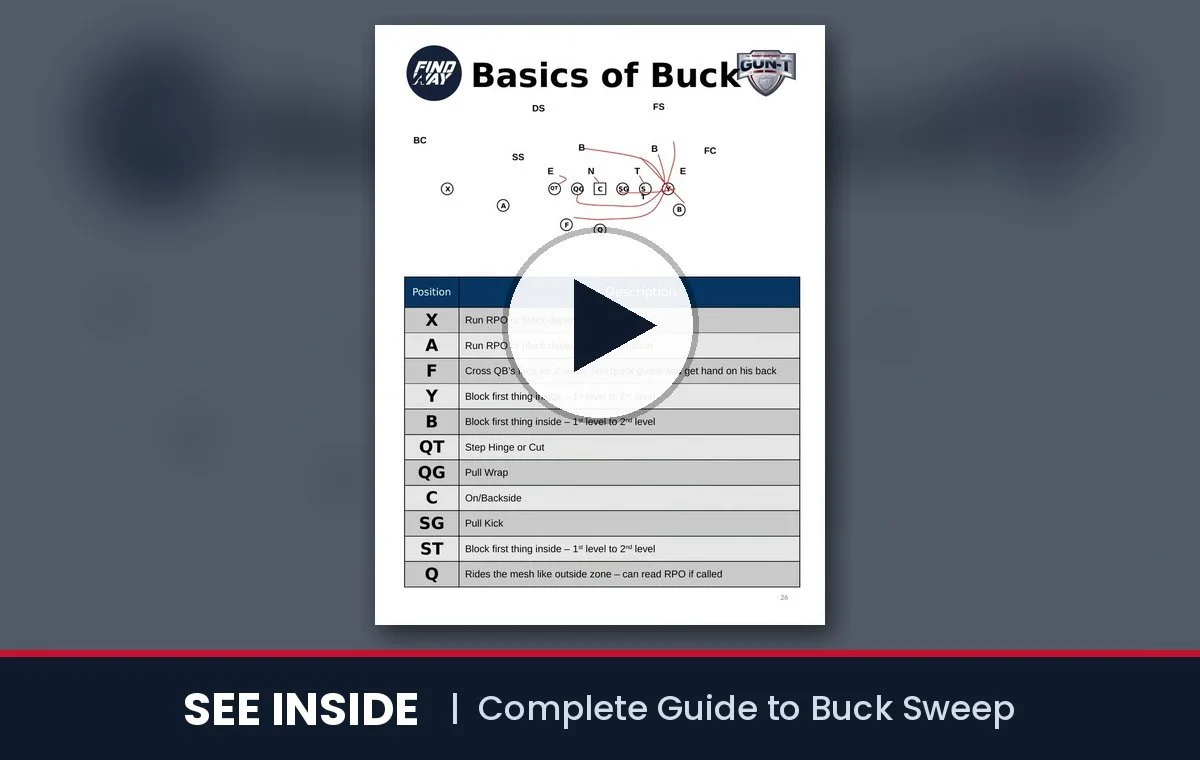
If you want the individual period work that cleans this up, the Buck Sweep drill video is free, and the Complete Guide to Buck Sweep from the Gun teaches the play from the ground up, blocking rules and all. Coaches building the whole offense around it start with the Gun T RPO Playbook.