You've seen this look. It's Friday night, you break the huddle, and the defense has eight guys crowded down near the line of scrimmage. Two of those safeties have walked up. They're outnumbering your box, they're daring you to run into it, and if you've got a young quarterback, they're daring you to throw over the top too. A lot of coaches see that and start drawing up new plays in the middle of the week, hoping one of them is the answer.
That's usually the wrong move. When you're facing a 4-4, the problem isn't that you don't have enough plays. The problem is that you're trying to block a defense that has more hats in the box than you have blockers, and no play call fixes bad math. What fixes it is making the defense wrong before the ball is ever snapped.
Why the 4-4 gives offenses trouble
The 4-4 is built to stop the run, plain and simple. Four down linemen, four linebackers, everybody fitting a gap, everybody flowing hard to the football. Against a team that lines up in the same formation every snap and runs downhill into the teeth of it, the 4-4 will win most of the night. Those linebackers are fast, they're aggressive, and they've been coached to trigger the second they read run.
But that aggression is also the crack you're looking for. A defense that flows fast is a defense you can get moving in the wrong direction. A defense that fits every gap by rule is a defense you can outflank by adding a gap it didn't account for. You don't beat the 4-4 by being tougher than it. You beat it by making eight defenders guard the whole field instead of just the box.
Make them wrong with formation
The first answer is formation, and specifically getting unbalanced. When you shift a lineman or bring a wing over and create an extra gap to one side, that 4-4 now has to account for a gap its rules didn't plan for. Either they bump everybody over and leave the backside soft, or they stay put and you've got an extra blocker at the point of attack. Now the math is even, and even math is all a good running team needs.
This is the whole reason I lean on unbalanced sets against loaded fronts. You're not asking your kids to learn ten new plays. You're running the same plays you've already installed, just from a picture the defense hasn't drilled against. Their coaches spent all week fitting your base look. When you line up unbalanced, a lot of that preparation goes out the window on the first snap.
Attack the edge and use the whole field
The 4-4 is strongest between the tackles because that's where all eight defenders live. So stop trying to win there every snap. Get to the edge. Sweep, jet, toss, anything that stretches those aggressive linebackers horizontally and makes them run sideline to sideline instead of downhill. Once they start widening to stop the edge, the middle they were so proud of starts to open up, and that's when your inside runs hit.
Motion does the same job before the snap. When you send a back or a receiver in motion, that 4-4 has to declare what it's doing. It has to bump a defender, rotate a safety, or check the call, and every one of those reactions tells your quarterback something and pulls a defender out of position. You're not adding plays, you're adding information and stress.
Punish the flow with misdirection
Here's the part coaches forget. The very thing that makes the 4-4 hard, all that fast flow to the ball, is what makes it easy to trick. Run your sweep two or three times and get those linebackers chasing it. Then hand off counter the other way and watch them run themselves right out of the play. Same footwork from your backs, same look at the snap, opposite result.
Misdirection is how a smaller, less athletic team beats a defense full of fast, downhill linebackers. You let their aggression do your work for you. If your system only works when you're more talented than the other team, it doesn't really work. Against the 4-4, a good counter game is the great equalizer.
What to do this week
If you've got a 4-4 team on the schedule, here's where I'd start:
- Put in at least one unbalanced formation and run your three best plays from it, nothing new to learn.
- Script your first two series to attack the edge and get the linebackers flowing wide.
- Have your best counter play ready off that same edge action, and call it the snap after they start over-pursuing.
- Add one motion to every base formation so the defense has to declare and adjust.
- Keep the actual play list short. You're changing the picture, not the offense.
The goal isn't to be clever. It's to be effective on Friday night, and against a 4-4 that means making eight defenders guard grass they weren't planning to guard.
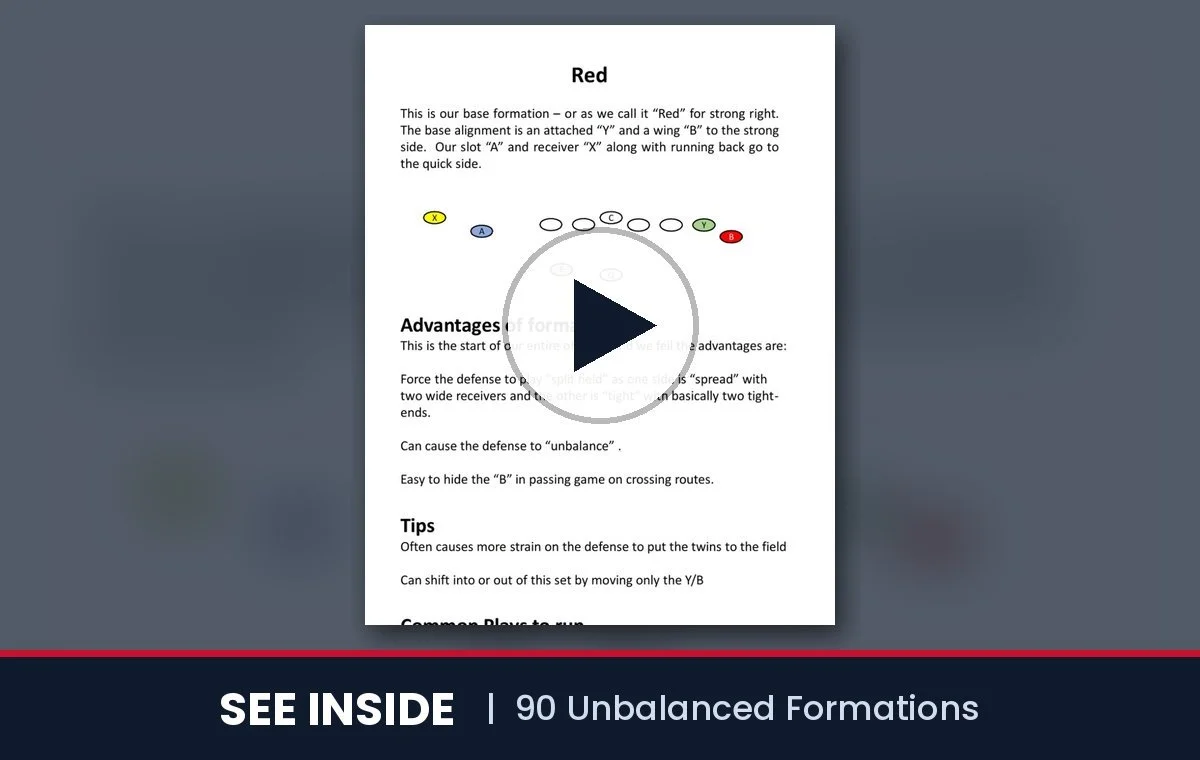
If you want the full breakdown of how the Gun-T attacks loaded box defenses, the Gun T System 5.0 Book walks through the base offense and the answers built into it. And if the formation piece is where you want to start, the 90 Unbalanced Formations guide gives you ready-made looks that stress a 4-4 without adding a single new play for your kids to learn. And if you want to see how the whole offense is built to create these looks in the first place, the Powerpoint Shotgun Wing T Overview is a free walkthrough of the system.