Building Champions in the Trenches
From this podcast: https://www.youtube.com/watch?v=GGvm64l_IZE
Offensive line play often goes unnoticed by casual football fans, but coaches know it's the foundation of any successful team. In a recent episode of the Coaching 101 podcast, veteran offensive line coach Tony Schiffman shared invaluable insights about developing players in football's most demanding position group. Here are six key takeaways that can transform how we approach offensive line coaching.
• **Make the Position Desirable Through Incentives and Culture**
Why this matters: Most young athletes dream of scoring touchdowns, not blocking for others. Creating a culture where offensive linemen feel valued is essential for program success.
Successful programs treat their offensive linemen like royalty - they eat first, get the best equipment, and receive constant recognition. Coach Schiffman emphasizes selling the brotherhood and special bond that exists among linemen. When players understand they're part of an elite group that "takes a special kind of person," they begin to embrace the role. The key is helping them realize that being a starter on the offensive line is better than being a fourth-string skill position player.
• **Focus on Fundamentals Over Flashy Techniques**
Why this matters: In the age of social media highlights, coaches often skip basic skills in favor of complex schemes, leading to poor execution when it matters most.
The most overlooked aspect of offensive line coaching is teaching proper fundamentals - stance, first step, hand placement, and angles. Many coaches jump straight to scheme concepts without ensuring players can execute basic blocks correctly. As the podcast guests noted, there are more bad offensive line coaches than good ones at the high school level, often because they focus on the "big picture" while neglecting the technical details that make plays successful.
• **Gap Schemes Are Easier to Teach Than Zone Concepts**
Why this matters: Simplicity leads to better execution, especially with limited practice time and varying skill levels in high school football.
Both coaches agreed that gap schemes (like power and counter) are more straightforward to install than zone blocking. Gap scheme rules are clear-cut: "If there's someone in your gap, block them. If not, go get a linebacker." Zone schemes require more complex decision-making and extensive double-team work, which can be "expensive" in terms of practice time. For most high school programs, gap schemes provide better results with less installation time.
• **Teach the "Why" Behind Every Block**
Why this matters: Modern players want to understand the purpose behind their assignments, and this knowledge actually improves their performance.
Today's players constantly ask "why," and coaches need solid answers. When linemen understand that their down block is designed to seal a defender so the play can go outside, they can better adapt when things don't go perfectly. Teaching the concept first, then the technique, then putting it all together helps players make better decisions during games. This approach also helps players understand that they don't need to pancake every defender - sometimes just getting in the way is enough.
• **Keep Instructions Simple for Your Least Talented Players**
Why this matters: Offensive line coaches are often the smartest coaches on staff, but they can overcomplicate things for players who struggle academically.
The "what not to do" lesson emphasized coaching to the lowest IQ in the room. Using complex terminology and multiple "if-then" scenarios can overwhelm players who are already learning a difficult position. Since offensive linemen won't touch the ball, they need simpler rules than skill position players who are motivated to learn complex route trees. Clear, basic instructions lead to better execution than sophisticated schemes that confuse players.
• **Prioritize Offensive Line Coaching in Your Staff Hierarchy**
Why this matters: The offensive line coach should be one of your first and most important hires, yet many programs treat it as an afterthought.
The podcast guests argued that the offensive line coach should be among the top three hires for any head coach, alongside the opposite coordinator and strength coach. Poor offensive line play is immediately visible to fans and administrators, making it a position that can get coaches fired quickly. Yet many programs assign offensive line duties to whoever is available rather than finding a qualified coach who understands the technical aspects of the position.
Conclusion
Offensive line coaching requires a unique blend of technical expertise, motivational skills, and strategic thinking. By focusing on these six principles - creating a desirable culture, emphasizing fundamentals, choosing appropriate schemes, explaining the "why," keeping things simple, and prioritizing the position in staffing decisions - coaches can build the foundation for sustained success. Remember, as these experienced coaches noted, every play matters for an offensive lineman, making their development crucial to any team's championship aspirations.
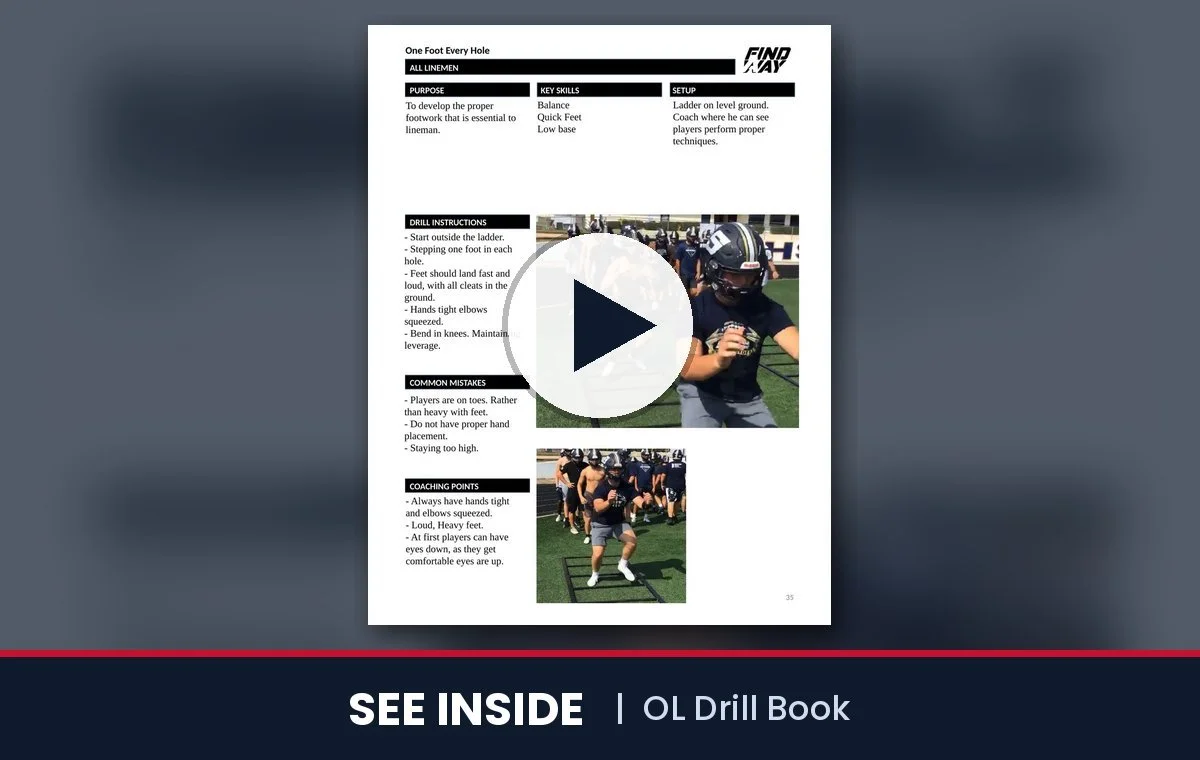
Line play gets talked about the least and decides the most. The Offensive Line Drill Book is the daily work, the Offensive Line Combo Pack puts the teaching and the drills together, and the Buck Sweep Drill Video is free if you want to see how those drills show up inside a real play.