Ask ten high school defensive coordinators why they run their defense, and half of them can't give you a real answer. They run it because their old head coach ran it, or because they saw it on TV, or because it's got a cool name. That's not a reason, that's an inheritance. When I settled on the 3-4 defense for our high school program, it wasn't because it was trendy. It was because it did three things I need every defense to do. It's gap-sound, it's aggressive, and a fifteen-year-old can actually learn it and play fast.
Most defenses fail in high school for the same reason most offenses do. They're built for a college roster and a college install schedule, and then you try to teach them to kids who have three practices a week and jobs and homework. The 3-4 Swarm is the answer I keep coming back to because it gives you an aggressive, sound defense that you can actually get installed and get playing fast, without a playbook the size of a phone book.
Why the 3-4 defense fits high school football
The first thing the 3-4 gives you is bodies in space. You've got four linebackers, which in high school means you can get your four best football players on the field and let them run. In a lot of programs your best athletes aren't your biggest kids, they're your linebacker types, tough and fast and able to run and hit. The 3-4 puts four of them in position to make plays instead of asking them to hold a gap and wait.
The second thing it gives you is gap soundness without a lot of thinking. With three down linemen and four linebackers, you can account for every gap with simple rules, and every kid can know exactly what he owns on every snap. That matters more than any exotic pressure, because in high school the offense usually beats you when somebody's in the wrong gap, not when they out-schemed you. A sound defense that everybody understands beats a fancy defense that half the kids are guessing in.
The third thing, and this is the one people underrate, is that it travels. Some weeks you'll see a spread team with four wide, and some weeks you'll see a Wing-T team that wants to run it down your throat. A good defense has to answer both without a total teardown from week to week. The 3-4 flexes across personnel by adjusting who's on the field and where they line up, not by reinventing the rules. Your kids keep the same fits and the same language whether they're playing a passing team or a downhill running team, and that consistency is worth more than any single wrinkle.
Why the Swarm part matters
The Swarm piece is the attitude and the pursuit built into the scheme. It's not just a front, it's how we play. Everybody runs to the ball, everybody has a gap until the ball declares, and then everybody's flying. The reason that works with a simple front is that the rules are clean enough that kids can play fast, and speed to the ball covers a lot of mistakes. A missed tackle isn't a touchdown when eight guys are swarming to the football, because the next kid cleans it up.
That's the quiet genius of it. You don't need every kid to be great. You need every kid to know his gap and run to the ball, and the scheme does the rest. That's exactly what you want in high school, where your talent is uneven and your practice time is short. If your defense only works when all eleven are studs, it's going to let you down the week two of them are hurt.
How to install the 3-4 Swarm without overwhelming your kids
Here's where most coordinators lose the plot. They love the defense, so they try to install all of it in the first week, every front, every stunt, every coverage, and the kids drown. Then they play slow because they're thinking instead of reacting, and the coach decides the defense doesn't work. The defense works fine. The install was wrong.
The way you install the 3-4 Swarm is the same way you eat anything big, one bite at a time. You teach the base front and the gap responsibilities cold before you add a single wrinkle. If the kids can't line up and be gap-sound in your base call, they've got no business learning a blitz. Get the foundation to where it's automatic, then build on it.
- Install the base front first, and only the base front. Every kid learns his alignment and his gap in your one base call. Rep it until nobody has to think about where to line up.
- Teach gap fits against run before you touch coverage. Fit the run cold, both directions, against the run styles you'll actually see. This is where games are won or lost.
- Add one adjustment for spread sets. One simple answer for when they go four wide, so your kids aren't panicking against an empty set. One answer, not five.
- Layer in your primary pressure once the base is automatic. Pick the one blitz you'll live on and rep it until it's clean. You can add the second one next week.
- Build the coverage last, keep it simple, and tie it to the front. Two or three coverages your kids can play with confidence beats six they play tentatively.
Notice the order. Front, then run fits, then a spread answer, then pressure, then coverage. Every step sits on top of the one before it, so nothing you teach gets thrown away, and a kid is never asked to learn the hard stuff before the easy stuff is automatic. Do it this way and you'll have a defense that plays fast in September instead of one that finally figures it out in November.
Keep it simple, and let them play fast
The point of all of this is speed and confidence. A kid who knows exactly what he owns plays a half-step faster than a kid who's processing, and a half-step is the whole game on defense. The 3-4 Swarm gives you an aggressive, gap-sound defense that a normal high school roster can learn and play fast, and it holds up across the different offenses you'll face. That's the entire test. It has to be sound, it has to be teachable, and it has to hold up on Friday night.
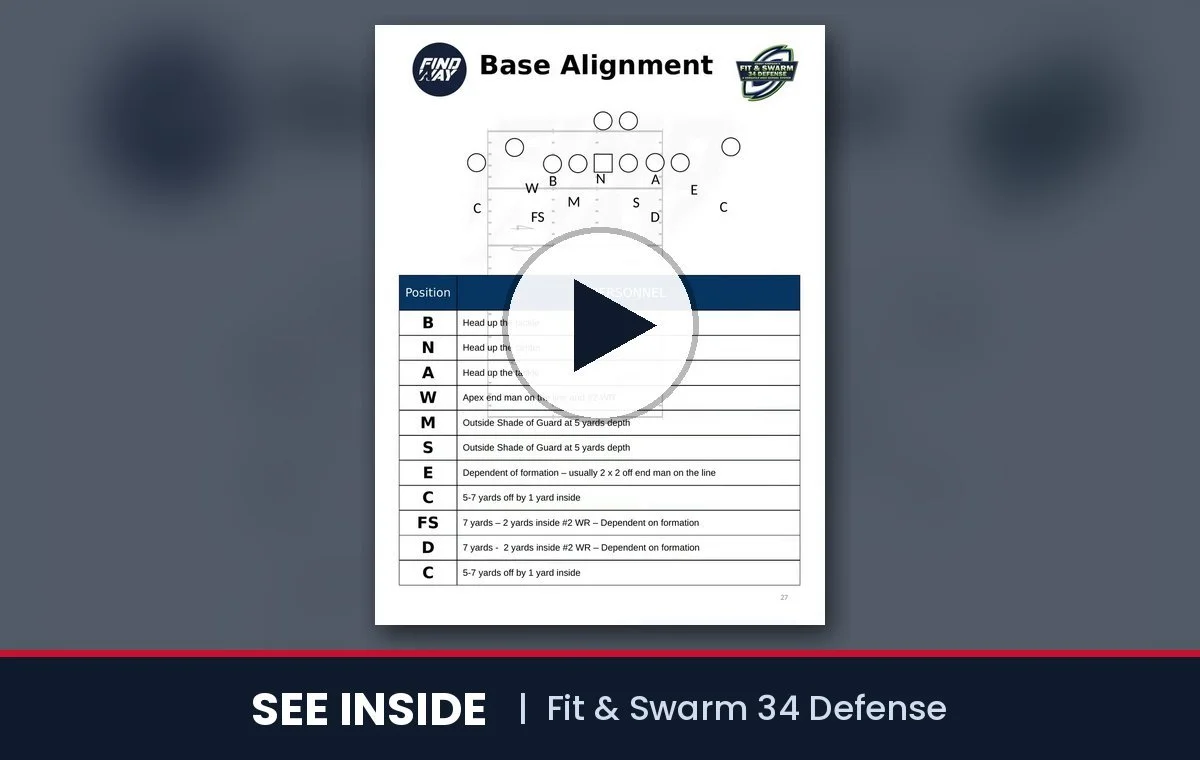
If you want to see the fits and the philosophy laid out the way I actually teach them, start with the 34 Fit and Swarm Overview Book. When you're ready for the whole system, the fronts, the pressures, and the coverages that fit together, the 34 Swarm Combo Pack is the full package. And if you want to run it like a program, install schedules, practice organization, and how to teach it to a real roster, the 34 Organizational Manual ties it all together. Install it one bite at a time, and let your kids play fast.
The 3-4 Defense Overview is free and is the quickest way to see whether this fits what you have. The 34 Swarm 2.0 Update Book is the current version of the whole defense, and the 34 Defensive Line Manual covers the front, which is where the install usually lives or dies.