If you run a downhill, pulling offense, your offensive line drills have to look like your offense. That sounds obvious, but walk into a lot of practices and you'll see linemen doing board drills and sled work that have nothing to do with the buck sweep they're going to run forty times on Friday. The drills feel like coaching, everybody's sweating, but nothing on that field shows up in the game. If your guards can't pull and fit a linebacker in space, none of those pretty sleds matter.
I keep my offensive line drills simple and I keep them tied directly to what we ask on Friday. We pull, we trap, we down block, and we climb to the second level. So that's what we drill, every single day, in the same footwork we use in the game. You don't need forty drills. You need a handful that transfer, done right, done every day.
Build your offensive line drills off your actual blocks
Everything starts with the first step, because in a pulling run game the first step is the whole block. A down block that starts with a false step is a defender in your backfield. A pull that starts flat is a guard who's late to the hole. So before we ever fit up on anybody, we rep footwork alone, slow and clean, until the first two steps are automatic and nobody has to think about them.
From there I want the drill to end in contact, because a block that never fits a body isn't a block, it's a dance step. Footwork gets you there, but the kid has to feel a defender at the end of it or the drill lies to you. Here's the daily menu I keep coming back to.
- Pull and fit. Guard pulls, works to a bag or a held shield in the hole, and fits up with his eyes and hips square. Start it walk-through slow, then speed it up as the steps clean up.
- Trap footwork. Short pull, tight to the down lineman, and take him where he wants to go. Rep the angle until the trapper stops chasing and starts blocking the defender's momentum.
- Down block combo. Two linemen, down block to a double, then one climbs off to the linebacker. This is where a downhill run game gets its movement, and it takes daily reps to time it up.
- Second-level fit. Lineman climbs to a moving linebacker (a coach or a scout kid with a shield) and has to break down and fit in space. Missing in space is what kills these plays, so drill it live and drill it moving.
- Pulling track. Guards pull down the line at game speed with no contact, just to groove the path and depth. Two minutes of this a day keeps pullers from bellying or going flat.
Footwork first, then fit up on the second level
The hardest block in a downhill run game isn't the down block at the point of attack, it's the guard or tackle who has to climb and hit a moving linebacker in space. That's where drives stall. A kid who fits that block turns a four-yard gain into a house call, and a kid who whiffs it gives the play back. So I spend real time on second-level fits, and I make the target move, because a linebacker on Friday is never standing still waiting to get blocked.
Coach the breakdown. As the lineman closes, I want his feet under him and his eyes on the near number, not lunging and grabbing. If he lunges, the backer slips him and makes the tackle. If he breaks down and fits, he steers the kid out of the hole. That's the block that shows up in the box score, and it only gets better with reps against a moving body.
Keep it small and make it transfer
You could add ten more drills, but you'd be trading reps you need for variety you don't. I'd rather my linemen do five drills a thousand times than fifty drills once. If your best guard is the only one who can pull and fit, you're one injury from your offense falling apart. If your system only works for your best players, it doesn't work, so drill it until the whole line can execute it and everything holds up when the lights come on.
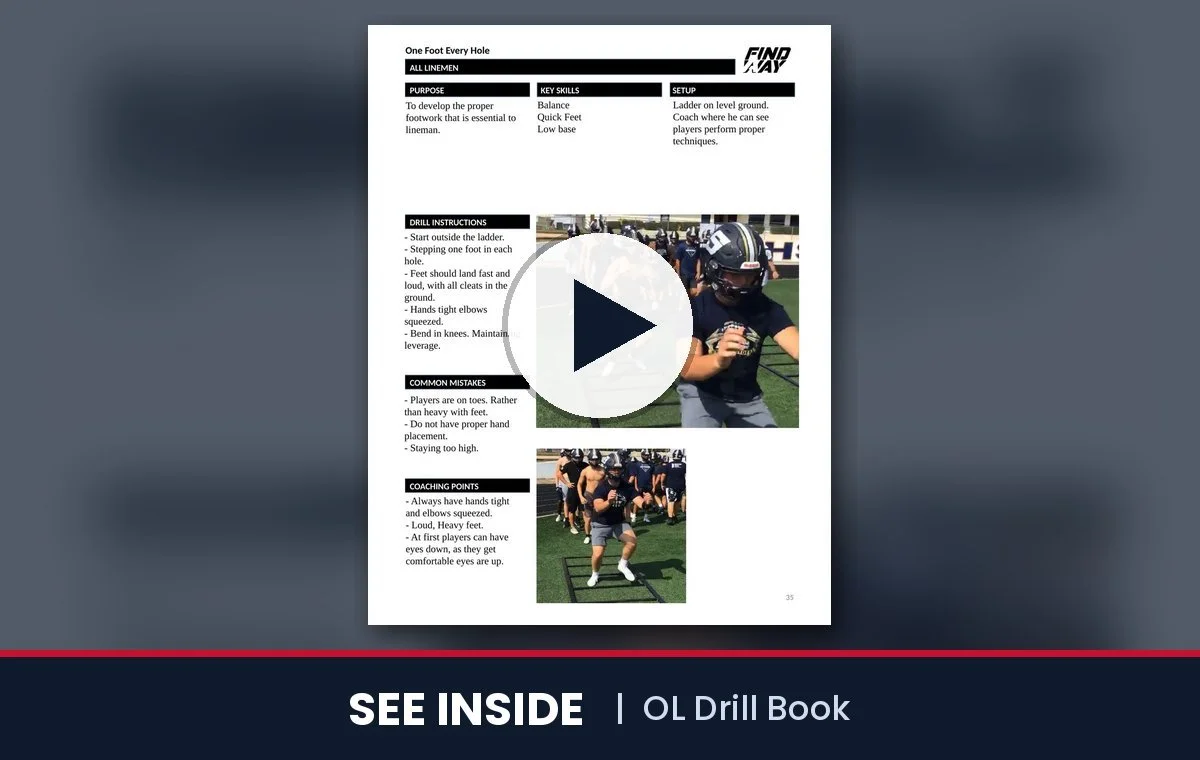
If you want the full teaching progression, the stances, the steps, and how I install each block, that's in the Offensive Line Manual. And if you want the drills themselves, laid out with the setups and coaching points so you can drop them straight into practice, the Offensive Line Drill Book gives you the daily menu. Pick a few, do them every day, and make sure they look like Friday.
Pulling is a skill, and it gets better with daily reps that look the same every time. The Offensive Line Drill Book has the progression, the Buck Sweep Drill Video is free and shows the pulls inside the play, and the Offensive Line Combo Pack puts the teaching and the drill work together.