Most of the quarterback run game problems I see don't come from bad scheme. They come from a coach trying to run somebody else's quarterback. You watch a clinic, you see a kid who can pull it and run away from everybody, and you go home and install a bunch of quarterback keeps for a kid who runs a 5.2 and thinks like a point guard. Then Friday shows up and none of it works, and you blame the plays. The plays were fine. They just weren't built for the kid taking the snaps.
The whole point of a quarterback run game is to make the defense wrong by numbers, not to turn your QB into a tailback. Once you accept that, coaching the run game gets a lot simpler, because now you're building around what your kid actually does well instead of hiding what he can't do.
Start with an honest read on your quarterback
Before you draw up a single quarterback run play, be honest about the kid. Can he run, or can he just move? Those are different things. A kid who can move can carry out a fake, get four yards on a keep when the read gives it to him, and slide before he gets hit. A kid who can run will make you miss and change a game with his legs. You coach those two quarterbacks completely differently, and the mistake is treating them the same because they play the same position.
If you've got a runner, great, you can lean on him and make him part of the count. If you've got a thrower who happens to play quarterback, you don't abandon the run game, you just change what you're asking it to do. A non-runner can still hold a backside end, still give the ball on a zone read every single time and freeze the defense doing it, and still be part of the numbers even if he never keeps it twice a game.
QB run reads that protect the quarterback
The best thing the quarterback run game does for a non-runner is let him win without ever carrying the ball. That's the part coaches miss. A read play is a numbers play first and a keep play second. If you're reading the backside end and he crashes, the give hits for a big gain, and you never asked your quarterback to do anything but hand it off and stand there. You just took a defender out of the play with your eyes.
So when you're teaching qb run reads, teach the give as the answer most of the time. Make the defense stop the give before you ever ask your quarterback to pull it. When he does keep it, give him a clean path and a way out. Nobody wants their quarterback taking twelve hits a game, and you don't need him to. If your read is coached right, the threat of the keep is doing most of the work whether he keeps it or not.
Here's how I'd build it with a limited runner:
- Make the give the default. The quarterback pulls only when the read clearly tells him to, not on feel. Take the guesswork out.
- Pick one read defender and rep it. One conflict defender your kid can see and trust. Don't ask him to read two things at once early.
- Build in a giveup. Teach him when to just get down or get out of bounds. A live quarterback in the fourth quarter beats four extra yards.
- Use the keep as a changeup, not a base. A handful of designed keeps a game keeps the end honest without exposing your QB every snap.
Turn the quarterback into a number, not a ballcarrier
The real value here is math. When you can read a defender or option him off, you've effectively blocked him with your quarterback's eyes, and now you've got a hat for a hat everywhere else. That's true whether your QB is a burner or a statue. A defense that has to account for the quarterback keep, even a little, has one fewer defender to gang up on your tailback. That's the advantage, and you can have it without ever putting your best passer in harm's way.
We're not trying to be clever, we're trying to be effective. The offense that wins on Friday is the one built around the kids you've got, and the quarterback is the biggest piece of that. Coach the one in your huddle, not the one in the highlight video.
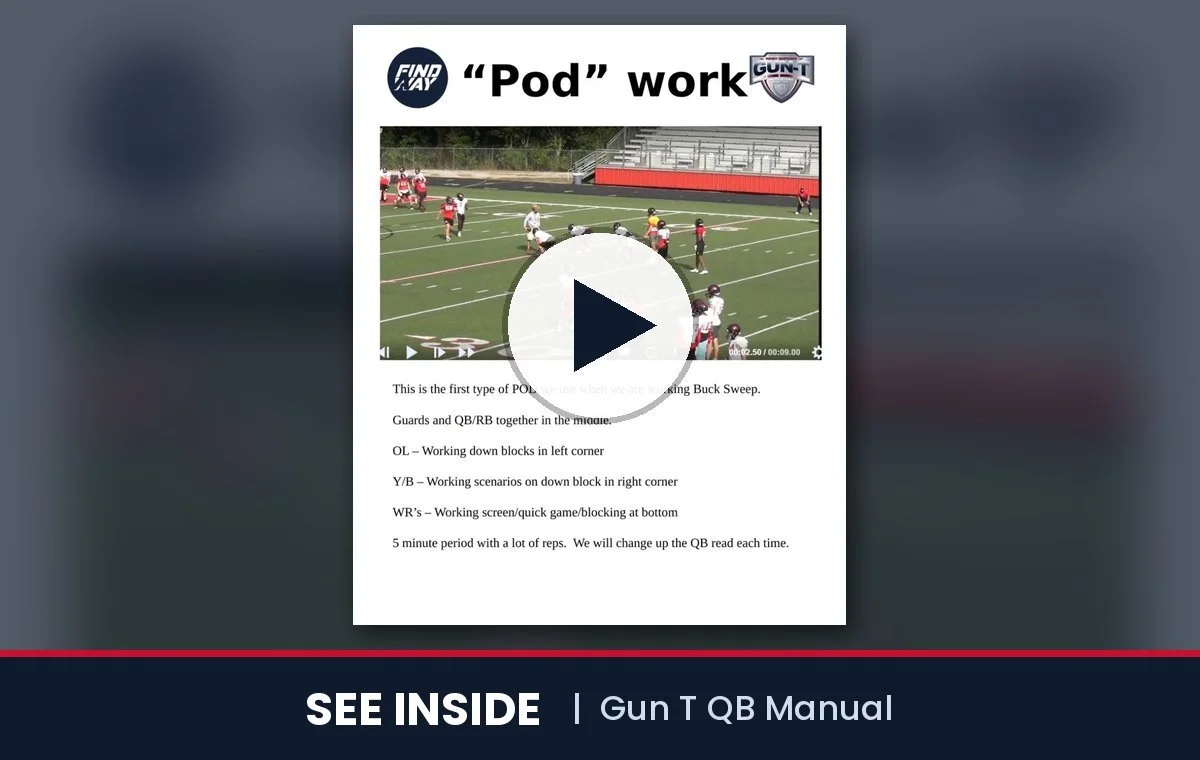
If you want to see exactly how I install the quarterback run game, the reads, the footwork, and how I coach it for both a runner and a non-runner, that's laid out in the Gun T QB Manual. And if you're trying to figure out how to shape the whole offense around the quarterback you actually have this year, the Adjusting to Your QB PPT walks through the decisions season by season. Build it around your kid first, then go teach it.
The quarterback run game has to fit the kid you have, not the one in the clinic video. The QB Coach Workbook gives you the week-to-week structure to develop him, the 9/8 Man Gun T Playbook is worth a look if you are working with smaller numbers, and the Gun T RPO Playbook shows where the quarterback run fits inside the rest of the offense.