Walk into most high school practices at the end of the day and you'll find special teams getting about five minutes and a prayer. The kids are tired, the coaches are ready to go home, and somebody rolls a ball out for kickoff coverage while half the staff is already talking about tomorrow. Then Friday night comes, a punt gets blocked, a return goes to the house, and everybody stands there wondering how a close game got away. It got away because special teams is a full third of the game and you treated it like a chore. Offense, defense, and special teams. That third phase decides more close games than either of the other two, and most staffs act like it's an afterthought.
I've been guilty of it myself, so I'm not preaching from a mountaintop. Early in my career I put my worst kids on the punt team and figured we'd survive. We didn't always survive. What changed my thinking was a simple truth about field position. Every yard you steal or give away in the kicking game is a yard your offense and defense have to earn or defend the hard way. That's hidden yardage, and over four quarters it adds up to more than any single drive you'll script all week.
Why special teams is where the smaller team steals a game
Here's the part that ought to get your attention if you're the program that's always a little short on talent. Special teams football is the great equalizer. You don't need the biggest, fastest roster to cover a punt, block a kick, or win the field position battle. You need effort, want-to, and eleven kids who know their assignments and run full speed. That's coachable. That doesn't require a Division I recruit at every spot.
When you're playing a more talented team, you are not going to out-athlete them for four quarters. But you can flip a field on them. You can down a punt at the three, block a PAT, pop a return when they've stopped keying it. One play in the kicking game can be worth two touchdowns of momentum, and it doesn't care how many stars anybody had. If your system only works for your best players, it doesn't work, and nowhere is that more true than special teams, where the whole point is that ordinary kids playing hard can beat better athletes playing lazy.
Put real players on your core units
The first mistake I see is coaches hiding their worst kids on special teams to keep them off offense and defense. Flip that thinking. Your punt team, your punt return, your kickoff coverage, those are live plays that can end a game. Put real players out there. Your gunner on punt needs to be one of your better athletes because his job is to change field position by himself. Your protection needs kids who will actually block. You don't have to load every starter onto every unit, but the core units deserve real football players, not the guys you're trying to get reps for.
The second mistake is scheme. Coaches get cute, install some exotic return with three reverses, and the kids play slow because they're thinking. We're not trying to be clever, we're trying to be effective. Keep the schemes simple enough that a kid can line up and play fast without hunting for his assignment. Fast and sound beats complicated and confused every single Friday.
The units that matter most
Not every phase carries the same weight, so spend your time where it pays off. Here's how I rank them and what to demand from each.
- Punt is the most important play in football. It's the one snap where a mistake hands the other team points or a short field instantly. Protect first, cover second, and never take the operation for granted. A clean punt that flips forty yards of field is worth more than most offensive plays you'll call.
- Punt return is your best shot at hidden yardage. You don't need a big return every time. A solid catch and ten yards, or a good hold that gives your offense the ball at the forty instead of the twenty, wins the field position war over a game.
- Kickoff coverage is effort made visible. This is where want-to shows up on film. Eleven kids sprinting in their lanes, staying disciplined, and tackling in space. It's the purest test of whether your team plays hard.
- The placekick and PAT operation has to be automatic. Snap, hold, kick, every time, under pressure. In a one-point game the PAT you botched in September is the game you lost in October. Rep the operation until it's boring.
How to actually practice it
None of this matters if you tack special teams onto the end of practice when everybody's checked out. Script it into every practice the way you script offense and defense. Ten focused minutes early, when legs are fresh and minds are sharp, beats twenty tired minutes at the end. Rotate a unit or two every day so by Friday you've touched all of them with real reps at real speed.
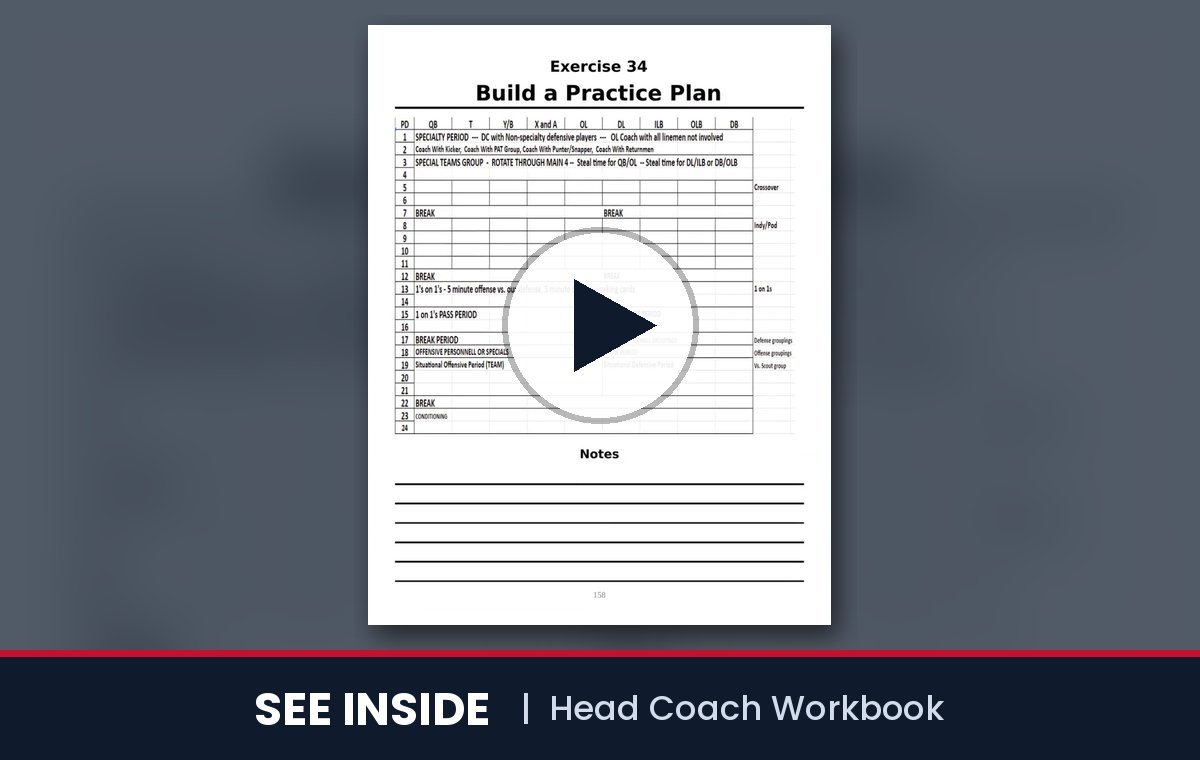
You don't need to be complicated, you need to be sound, assignment-perfect, and full speed. That's the whole message. If you want the schemes and the teaching progressions laid out, the Special Teams Book walks through every unit the way I coach it, and the Special Teams Ideas file gives you drills and wrinkles you can drop into practice tomorrow. And if you're a head coach trying to build all of this into how your program runs, not just your kicking game but your whole weekly structure, the Head Coach Workbook helps you put it on paper so it actually gets coached. Give special teams a real third of your attention, because it's a real third of the game, and it's where a team that has no business winning finds a way to win anyway.