A lot of coaches are working with what they've got, and what they've got up front is small. Your biggest lineman is 195 pounds, your guards are quicker than they are strong, and every week you're lining up across from a defensive line that outweighs you by fifty pounds a man. If you try to line up and drive block those kids off the ball, you're going to have a long season. I know, because I've coached those teams, and I've learned the hard way that the offense has to fit the players you actually have.
Here's the thing nobody tells you. Some of the best rushing offenses in football history were built by teams that couldn't win a straight-up shoving match. When you can't move a man straight back, you move him sideways, or you get him blocking air while your back runs past him. Small linemen can absolutely run the ball. They just can't run an offense built for big linemen.
Stop asking small kids to win a battle they can't win
The base drive block, hat across, push the man backward, is a strength play. It rewards the bigger, stronger athlete, which means it's the one thing you don't want your offense built on when you're the smaller team. Every time you ask a 195-pound guard to move a 250-pound nose straight back, you're setting him up to lose, and you're setting your play up to fail.
So we stop asking. Instead of blocking a man where he is, we block him where he's going, or we take him at an angle where his size doesn't help him. Small linemen who are taught to use leverage and angles will hold up against much bigger kids, because you've changed the contest from strength to positioning, and positioning can be taught.
Win with angles, not with muscle
This is why gap-scheme running games are a gift to the undersized team. On a play like buck sweep or counter, your linemen aren't trying to blow a man off the ball. They're pulling, they're kicking out, they're down blocking a defender from an angle where he can't anchor. A down block asks your lineman to take a man who's already half-turned, which even a small kid can handle. A pull asks him to run and hit a defender in space, and running is something your quick, undersized kids are probably good at.
When you build your run game on angle blocks and pullers instead of straight-ahead drive blocks, size stops mattering nearly as much. You're using your best athletes, your guards, in space, and you're never asking anybody to win a battle of pure strength. That's the whole reason gap-scheme offenses travel so well across every level of football.
Make the defense wrong before the snap
The other equalizer for a smaller team is misdirection and movement. When you can't win with strength, you win by making the defense chase, guess, and be in the wrong spot. Motion, formation shifts, and a counter game that punishes fast-flowing defenders all do the same thing, they get the bigger, faster athletes on the other side moving in the wrong direction so their size never gets to matter.
A defensive lineman who's guessing is a defensive lineman you can block. A linebacker who's flowing hard to your sweep is a linebacker you can trap the other way with your smallest guard, because now you're hitting him from an angle while he's moving. Speed of thought beats size, and you control the speed of thought with what you show before the snap.
What a small-team offense should look like
If you're the undersized team, here's what I'd build on:
- A gap-scheme run game, buck sweep and counter, that blocks angles and pulls instead of driving.
- Down blocks and kick-outs instead of one-on-one drive blocks whenever you can get them.
- A counter and misdirection package to punish aggressive, over-pursuing defenses.
- Motion and formation variety so the defense is reacting instead of teeing off.
- A short, well-repped play list, because execution beats volume for a team that has to be precise.
The point is to build a system that works for the players you have, not the players you wish you had. If your offense only works when you've got the biggest kids on the field, it doesn't really work, because most years you won't. Build one that wins with angles, movement, and misdirection, and a small team can move the ball on anybody.
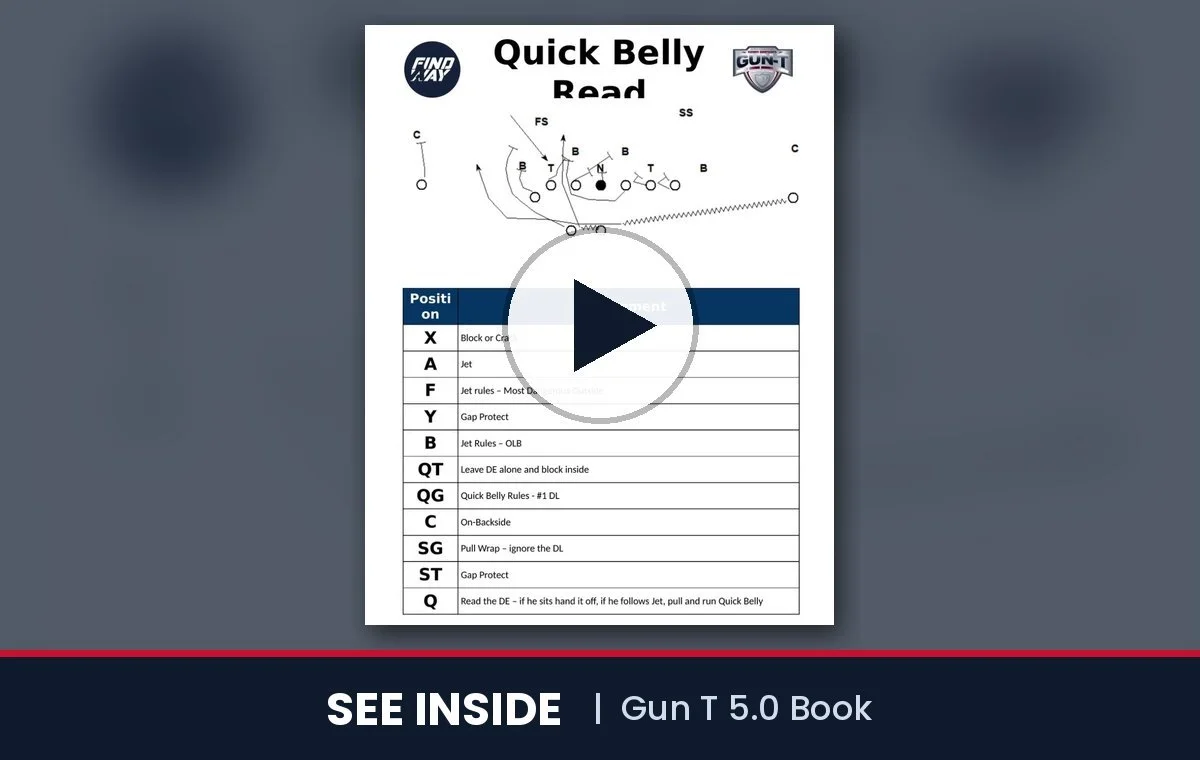
That's exactly what the Gun-T is built to do. The Gun T System 5.0 Book lays out the whole offense, an angle-based, misdirection run game that lets quick, undersized linemen play to their strengths instead of getting exposed by their size. If you've got a small line and a lot of heart, this is the kind of system that lets that heart show up on Friday night.