Everybody wants to talk about coverage and blitzes, but I'll tell you where defense actually gets won and lost on Friday night, and it's up front. Defensive line play is the least glamorous job on the field and the most important, because if your front can't control the line of scrimmage, nothing you draw up behind it matters. You can have the prettiest coverage in the county and it doesn't mean a thing if the offense is getting four yards a pop straight ahead because your defensive line got knocked off the ball. A sound front makes an average secondary look good. A soft front makes a great secondary look slow. So if you want to get better on defense, start with the big people, and start with three things: get-off, gaps, and getting off blocks.
I've coached the defensive line a long time, and the thing that took me too long to learn is that great defensive line play is not about being the biggest or the strongest. It's about beating the man across from you to the punch and knowing exactly what you own. Those are coachable things. You don't have to recruit them, you can teach them, and that's good news if you're a normal high school program with normal high school kids up front.
Get-off is the whole thing
If I could only coach one thing to a defensive lineman, it would be get-off. The ball is snapped and you move, first, low, and hard, on the movement of the ball. The offense knows the snap count and you don't, so the only way to make that fair is to react so fast and so violently that your quickness cancels out their head start. A defensive lineman who fires off the ball on the snap is a problem for any blocker, because now the offensive lineman is catching instead of striking, and a blocker on his heels is a blocker who gets beat.
Get-off is a habit, and you build it with reps, not a speech. Every day, off the movement, first step in the ground, hands inside, pad level down. We rep the get-off before we rep anything else, because a lineman who plays high and slow off the ball is going to lose no matter how good his moves are. Low man wins in the trenches, and the low man is usually the one who got off the ball first, because he never had to raise up.
Own your gap, then get off the block
The next thing is gap responsibility, and this is where a lot of high school defensive line play falls apart. Every front is a gap control scheme, and every lineman owns a gap. His first job is not to make the tackle, it's to control his gap so the run has nowhere to go and the linebacker behind him can run free. When a defensive lineman abandons his gap to chase a tackle he'll never make, he opens a lane, and that lane is a first down. Discipline in the gap is worth more than any pass rush move, because most of what beats a high school defense is a run through a gap somebody vacated.
But controlling a gap doesn't mean sitting still and getting blocked. It means you take on the blocker, you hold your ground in your gap, and then you shed him and make the play or fall off to the ball. That shedding part, getting off blocks, is what separates a defensive lineman who eats up space from one who makes plays. Here's how I teach the front to play blocks.
- Strike first with your hands inside. Get your hands on the blocker's chest before he gets his on yours. Whoever's hands are inside controls the rep. A lineman who lets a blocker get into his body is already losing.
- Get your eyes to the backfield. As you strike, your eyes find the ball. Feel the blocker's pressure, but see the play, because you can't get off a block toward a runner you never located.
- Press and shed to your gap. Lock out, feel where the ball is going, and throw the blocker the opposite way to clear your gap. Shed toward the ball, not away from it.
- Never get reached or turned. If a blocker gets his head across your face, he's about to seal you out of your gap. Fight pressure, keep your outside arm free, and don't let him turn your shoulders.
- Run to the ball every snap. If the play goes away, you don't watch it, you chase it. The best fronts have four guys sprinting to the ball on every play, and effort is the one thing that requires zero talent.
Rep those, and your front will control the line of scrimmage against people who are bigger than you, because you're beating them with technique and effort instead of trying to out muscle them.
Let them play fast and physical
The point of all this is speed and physicality up front, and both of those come from confidence, not size. A defensive lineman who knows he's got one gap and one job plays a half step faster and a lot harder than one who's thinking about too much. Keep his job small, drill his get-off and his hands every single day, and let him cut it loose. A front that gets off the ball, owns its gaps, and runs to the football will win you games your talent says you shouldn't win, because everything has to show up on Friday night and it shows up first in the trenches.
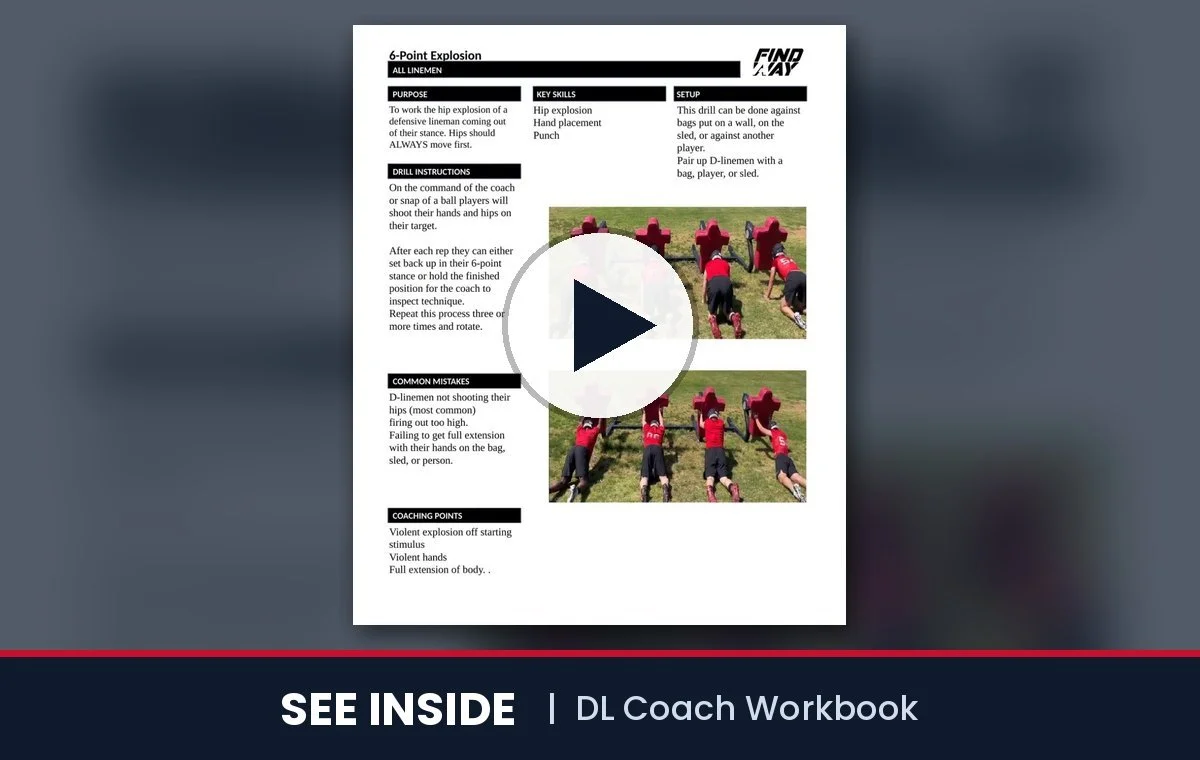
If you want the way I teach stance, get-off, hand placement, and block destruction to your front, that's laid out in the 34 Defensive Line Manual. To run the position like a coordinator with the drills and the daily plan built in, the Defensive Line Coach Workbook - Physical and Digital gives you the structure. And for how the front fits into the whole defense and the pursuit, the 34 Fit and Swarm Defensive Overview Book puts it in context. Coach the get-off, own the gaps, and get off blocks. The rest of the defense is built on that.