Every August I watch youth coaches make the same mistake, and I made it myself once, so I'm not throwing stones. They install way too much. Thirty plays in a binder, a formation for every situation, a wrinkle they saw a college team run on Saturday. Then Friday comes and eight of those thirty plays get called, four of them get run badly, and the two that actually score are the two the kids repped a hundred times. The best youth football offense isn't the one with the most answers. It's the one your whole roster can execute when they're tired, nervous, and the other team is bigger than expected.
Youth football is not a talent contest the way varsity is. You don't get to recruit, you don't get to cut, and half your team is out there because their buddy signed up. So the offense has to teach every kid, not just the three athletes you got lucky with. If your system only works for your best players, it doesn't work. That's true everywhere, but it's brutally true at the youth level where the talent gap between your best kid and your tenth kid is enormous.
Why fewer plays is the best youth offense
Reps win at this age. A kid who has run the same play forty times in practice knows his footwork, his aiming point, and his read without thinking. A kid who has seen a play four times is guessing, and guessing at full speed against live bodies looks like chaos. When you cut your playbook down to a handful of plays, every one of those plays gets more reps, and more reps means cleaner execution on Friday.
Master a few things that hit every part of the defense. A play that attacks inside, a play that gets outside, a counter that punishes them for chasing, and something off of it that keeps the linebackers honest. That's a full offense at the youth level. Run those four out of the same look, and you've given a ten year old defense more than it can sort out.
Let motion and misdirection do the work
Here's the part young coaches miss. You don't beat a youth defense with a better athlete, you beat them by making them wrong before the snap. Motion moves a defender and tells you what coverage you're getting. Misdirection sends the flow one way and hits back the other, and youth linebackers chase flow like puppies chase a ball. You can take the exact same handful of plays and dress them up with jet motion, a shift, or a fake, and suddenly the same four plays look like twelve to the defense while your kids are still only learning four.
That's the whole idea behind running the Gun T with youth teams. The quarterback keeps his eyes up, the mesh is simple to teach, and the motion and series football do the heavy lifting that talent would otherwise have to do.
What to actually do this season
If you want to build a youth offense that scores instead of one that looks busy, start here:
- Pick four to six core plays that attack inside, outside, and back against the grain. That's your whole offense. Resist adding more until those are clean.
- Teach every position to every kid in the first two weeks so you're not stranded when your starter is out or on vacation.
- Add motion, not plays. Run the same handful from different looks with jet, shifts, and fakes. New picture for the defense, same job for your players.
- Rep the core daily. If a play doesn't get run every practice, it won't hold up Friday. Volume of reps, not volume of plays.
- Keep the QB's eyes up. A simple mesh and a clean snap beat fancy footwork at this age every time.
The teams that score in youth ball aren't the ones with the thickest playbook. They're the ones where all eleven kids know exactly what to do, and the offense is built so the average kid can succeed, not just the star.
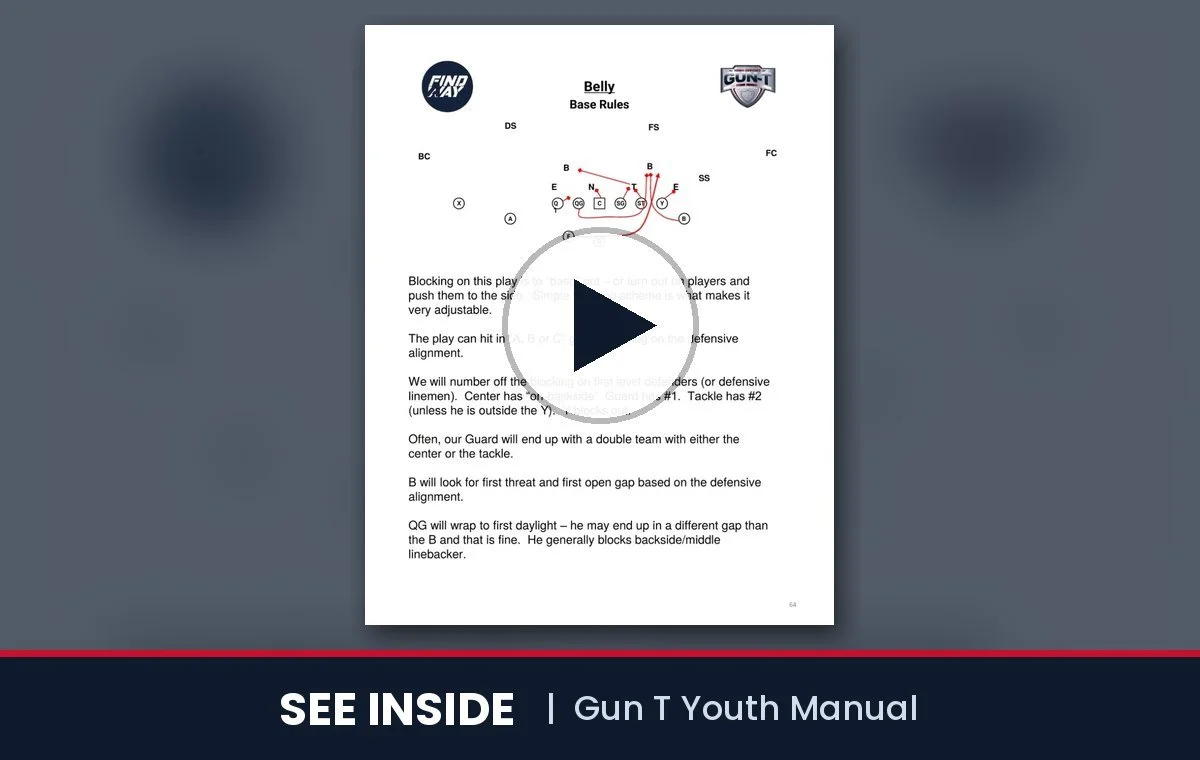
If you want the whole thing laid out the way I actually teach it to youth teams, the install order, the core plays, and how to fit it to the kids you have, that's what the Gun T Youth Manual walks through. And when you're ready to run real practices that develop the whole roster, the Youth Gun T Organization and Drill Manual gives you the practice structure and drills to teach it every day. Keep it simple, rep it hard, and let your kids play fast.
If your whole roster has to be able to run it, the offense has to be simple enough to teach and varied enough to still look different. The Gun T Youth Manual is written for that age group, Shotgun Wing T Overview is free and shows how the system fits together, and One Play, Five Looks covers getting more out of what you already run.