Most coaches try to fix a stalled offense by adding plays. New season, new install, ten more calls in the wristband. I understand the instinct, but it's backwards. A good formations offense doesn't beat you with more plays, it beats you by showing the same play from so many looks that the defense can never get lined up right. You already have plays that work. What you're missing is the ability to run them from a picture the defense hasn't fit yet.
Think about what a defense actually does before the snap. It counts your backs, it identifies your strength, it sets the front and rolls the coverage to match. Every one of those decisions is based on how you line up. Change the formation, and you force all of it to happen again. Add motion, and you force it to happen while the ball is about to be snapped, when there's no time to communicate and fix a mistake. That's the whole game, and none of it requires teaching your kids a single new play.
One play, many ways
Take your best run. Let's say it's your power. You can run power from a tight formation, from a spread look, from an unbalanced set with a tackle over, or with a wing added to the point of attack. It's the same play for your linemen and your back, the same footwork, the same aiming point. But to the defense it's a different problem every time, because your numbers and your leverage keep changing. One formation gives you a double team you didn't have before. Another puts an extra gap on the front side that the defense has to account for. Same play, new math.
That's the payoff of a formations offense. You get the defensive confusion of a huge playbook while your players are still only mastering a handful of assignments. Your kids get more confident because they're repping the same plays over and over, and the defense gets less confident because they can never trust their alignment.
Motion, shifts, and trades force a re-fit
Formations set the picture. Motion and shifts change the picture after the defense has already committed to one. When you shift a back or trade a tight end across the formation, you make the defense re-declare its strength and re-fit its gaps in real time. Youth and high school defenses handle that poorly, because most of them are coached to line up and go, not to adjust on the fly. You send a man in motion and watch a linebacker follow him, and now you know your leverage before you ever snap it.
Shifts and trades do something else too. They tell you what the defense is. If you trade your tight end and the corner travels with him, you've got man coverage. If the safety rotates instead, you're looking at zone. You haven't called anything yet, and the defense has already told you how to attack it. That's information you get for free, just by moving people around, and it costs you nothing in the play count.
How to build it into your offense
You don't overhaul anything to do this. You add looks to plays you already trust:
- Start with your three best plays. Don't touch the assignments. These are the plays you're going to dress up.
- Give each one two or three formations that change your numbers or your leverage at the point of attack. Same job for the players, new problem for the defense.
- Add one motion per formation that either moves a defender you want moved or tells you the coverage before the snap.
- Rep the shifts and trades slow first. The advantage only shows up if your kids line up fast and set before the snap, so drill the movement until it's clean.
- Keep a cheat sheet of what each look tells you. Trade travels means man, safety rotation means zone. Teach your kids to read it, not just run it.
The goal is leverage and numbers, created before the ball is snapped, without asking your players to learn more football. We're not trying to be clever, we're trying to be effective. A defense that's guessing at the alignment is a defense that's a half step slow everywhere, and a half step is all your offense needs.
If you want a full menu of formations built around the same run game, so you can run one play a dozen ways, the 90 Power Gun Formations gives you the looks and the reasoning behind each one. And when you're ready to add the movement that makes defenses re-fit on the fly, the Using Shifts and Trades PPT walks through how to build and teach them without adding to your install. Dress up what you already run, and let the defense do the guessing.
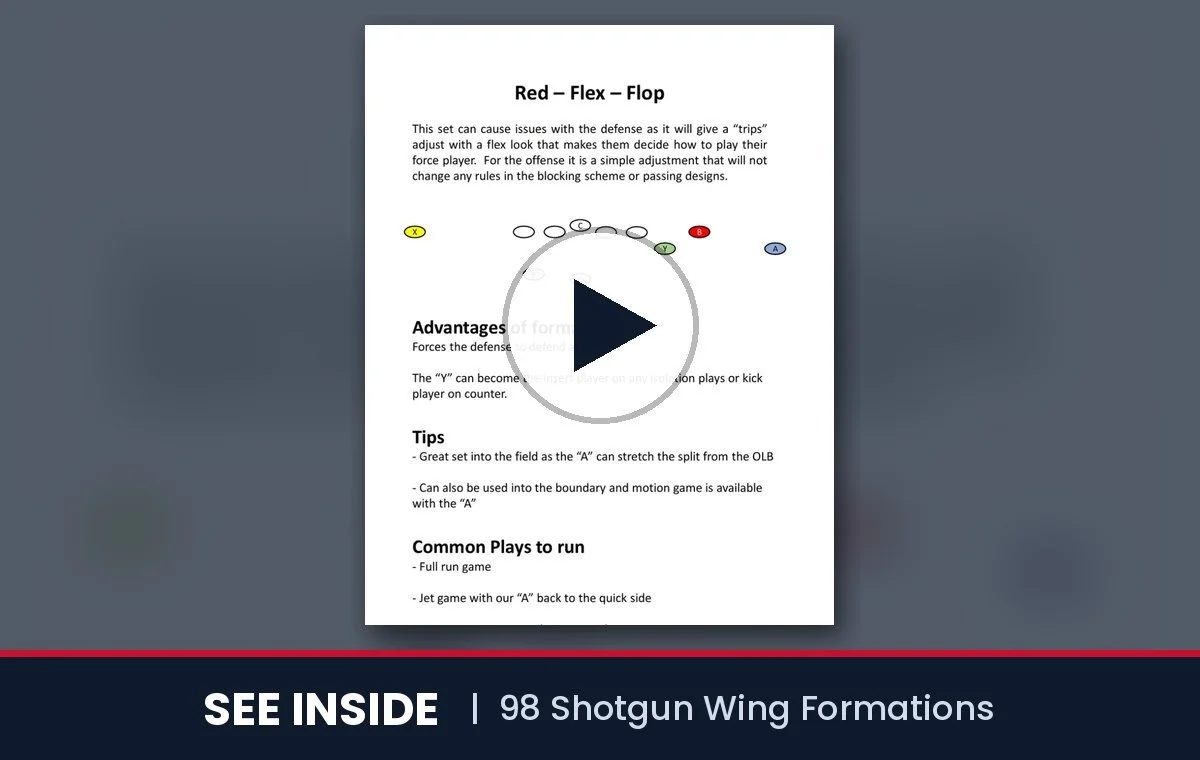
Formations and motion are the cheapest offense you will ever add, because your kids already know the plays. Using Formations and Shifts to Manipulate the Defense covers the how, 98 Shotgun Wing Formations is the full set to pull from, and the Formation Book Bundle puts the formation books together if you want all of it.