Every year I get coaches telling me they can't run the zone read because they don't have the quarterback for it. They watched somebody's stud pull the ball and run 60 yards, and now they think the play lives and dies on a burner at quarterback. It doesn't. The zone read is a numbers play, not an athleticism play. You leave the backside defensive end unblocked, you read him with the quarterback's eyes, and now you've blocked him with a decision instead of a body. That's the whole thing. You don't need a track star, you need a kid who can read one man and make a good handoff.
Here's the math that makes it work. When you're reading the defensive end instead of blocking him, you just freed up a blocker to go get somebody else. That's a hat on every other defender in the box. If you block that end with a body, you're a man short somewhere, usually on the backside linebacker who runs the play down. Read him instead and the numbers even out, and the defense can't load the box without giving you the keep. That's read option in its simplest form, and it's why the play has stuck around for so long.
Reading the defensive end is a rule, not a guess
The biggest mistake I see is coaches letting the quarterback read on feel. Feel gets you a fumble and a scoop and score. Reading the defensive end has to be a rule your kid can trust at full speed with a linebacker screaming downhill at him.
Pick one key and stay married to it. I read the near hip or the near shoulder of that first man past our down block, and I teach it as a give-first play. Default is the give, every time. If the end crashes down the line toward the mesh, that's the give being taken away, so the quarterback pulls it and gets into the space that end just vacated. If the end sits soft or widens to play the quarterback, hand it off and let your back run downhill through the gap that end left open. Give when he chases, keep when he sits. Make it that simple. Don't ask a 16-year-old to read the end and the linebacker and the safety all in one mesh. One key, repped until it's automatic.
The mesh itself has to be clean and it has to be quick. The quarterback puts the ball on the belly, reads on the ride, and either lets it go or pulls it out by the time the back clears his front hip. Ride it too long and you turn a fast decision into a slow one, and now the unblocked end recovers and tackles both of them.
The give makes the end wrong for crashing
Teach the give as the answer and you take all the pressure off the position. When that defensive end crashes hard to stop the dive, the give still hits because your line has walled off everything inside and that end took himself out of the play chasing a back who already has the ball. You made him wrong for doing his job. He can crash the dive or he can sit for the keep, he cannot do both, and whichever he picks, you run the other one.
That's how a kid who isn't a runner still makes this go. He doesn't have to keep it 15 times a game. He has to hold that end honest a few times so the end can't just tee off on the give. Even a slow quarterback who keeps it twice a night for four yards has done his job, because now the end has to respect him, and respecting him is what opens the give. If your system only works for your best players, it doesn't work. The zone read works for the quarterback you actually have.
But when he does keep it, protect him. Give him a clean keep lane off the butt of that end and a hard rule to get down or get out of bounds. A live quarterback in the fourth quarter beats four extra yards every time.
Coach these points before Friday
- Marry him to one read key. Pick the near hip or shoulder of the read defender and rep it until the give-or-keep decision is a rule, not a guess in traffic.
- Default to the give. Make the give the answer and only pull when the end clearly crashes, so a bad read costs you a handoff instead of a turnover.
- Keep the mesh quick. Decide by the time the back clears the front hip, because riding it too long lets the unblocked end recover and make the play.
- Build the keep lane and the giveup. Give him a clean path off the end's tail and a get-down rule so you never trade your quarterback for a few yards.
- Fix the bounce. Coach the give to hit the read gap downhill, not east and west, because a back who bounces every give hands the play back to the defense.
The other thing the zone read buys you is everything you can hang off it. Once the defense has to honor the read, you can tag it. A bubble to the perimeter, a slant off the backer who crashes, a quick hitch when the corner squats, that's your RPO tag, and now you're reading a second defender without asking your quarterback to do anything new. The zone read holds the box honest, and reading the defensive end is what makes those RPO tags live instead of hopeful.
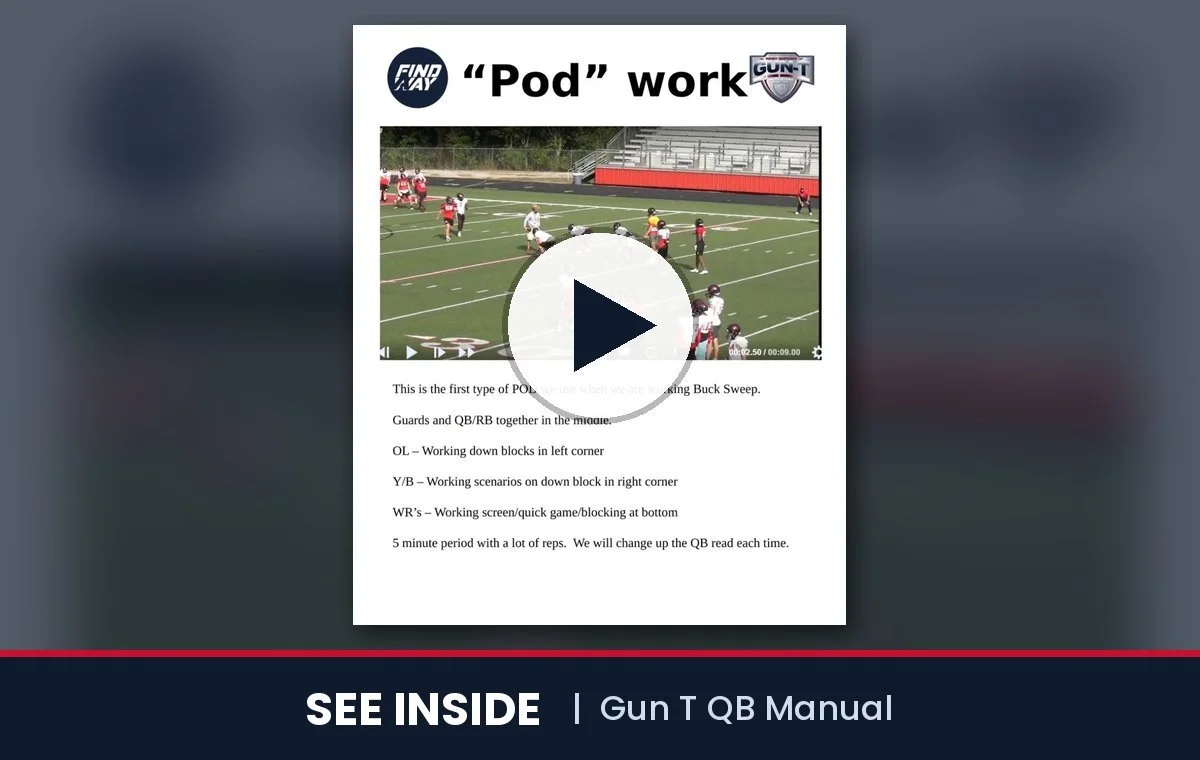
We're not trying to be clever, we're trying to be effective. If you want the footwork and the mesh coached step by step, that's in the Gun T QB Manual, and the Gun T RPO Playbook lays out the tags that come off this read. And if you're trying to fit all of it to the kid taking your snaps this fall, Adjusting to your QB in the Gun T System walks through those decisions. Coach the kid you've got, make that end wrong, and go win on Friday.
Any read play works better inside a system your kids already understand. The Gun T RPO Playbook is where the read game fits for us, the Buck Sweep RPO Series shows the same idea off buck, and the Gun T QB Manual has the quarterback side of the reads.