The buck sweep is one of the best plays in football, and it's also one of the most frustrating when it isn't right. You've seen it on film, you know it can carry an offense, so you put it in. Then Friday night comes and the play keeps dying in the backfield. Your back is getting hit before he turns upfield, your pullers are running into traffic, and you're standing on the sideline wondering if the play just doesn't fit your kids.
I've been there, and I'll tell you what I've learned after running this play for a lot of years. When the buck sweep gets blown up, it's almost never the play. It's one of a small handful of teaching errors, and once you know where to look, most of them get fixed in a single practice. Let's walk through the usual suspects.
Problem one: your pullers are too slow off the ball
The buck sweep lives and dies on the guards. If your guards are standing up, opening their hips late, or taking a false step, the play is already behind before it starts. The whole point of the sweep is to get two pullers around the corner ahead of the back, and if they're a half second slow, the back catches up to them and everything jams.
The fix is footwork, not effort. Your guards need to pull flat, get their eyes around the corner immediately, and trust their track. Most slow pullers aren't lazy, they've just been taught a first step that costs them time. Clean that first step up in a drill, on air, every single day, and the play speeds up on its own.
Problem two: the back is running to a spot instead of reading the block
A lot of young backs are coached to aim for a landmark, so they run to a spot on the field no matter what happens in front of them. The buck sweep doesn't work that way. The back has to run off the block of the play-side guard, tight if the guard kicks out, up inside if the guard logs. When the back sprints to a predetermined spot, he outruns his blocking and runs straight into the defender your guard was about to wall off.
Teach your back to press the line of scrimmage and read the puller's block. Slow to fast. He should be under control until the hole shows, then hit it downhill. A patient back behind good pullers is what makes this play a touchdown instead of a two-yard loss.
Problem three: you have no answer for the defender crashing the mesh
Sometimes the sweep gets blown up because the defense has cheated to it. A safety is flying down, an end is crashing hard inside, or a linebacker is shooting the exact gap your back is trying to reach. When that happens over and over, the answer isn't to run the sweep harder. The answer is to make them pay for cheating.
That's what the counter and the play-action pass off buck are for. The second a defender starts jumping the sweep, you fake it and hit him behind his own aggression. You don't have to out-scheme the defense, you just have to have the built-in answer ready so their over-pursuit becomes your big play. If you're running buck with no complementary plays off it, you're running it with one hand tied behind your back.
Problem four: you're blocking it the same way against every front
The buck sweep is not one blocking scheme, it's a set of rules. The way you block it against an even front is not the way you block it against an odd front or a defense that's slanting. When coaches install one blocking picture and never adjust it, the play works against one look and gets blown up against the other three. Your linemen need simple, clear rules that hold up whether there's a man over them or not.
What to fix first
If your buck sweep is struggling right now, work in this order:
- Fix the guards' first step and pulling track on air, every day, until it's clean.
- Retrain the back to read the play-side block and press the line, not run to a spot.
- Install one counter and one play-action pass off the exact same look to punish cheaters.
- Give your line front-by-front blocking rules so the play holds up against odd and even.
None of that requires new athletes. It requires better teaching of the play you already have, which is the whole idea. We're not trying to be clever, we're trying to be effective.
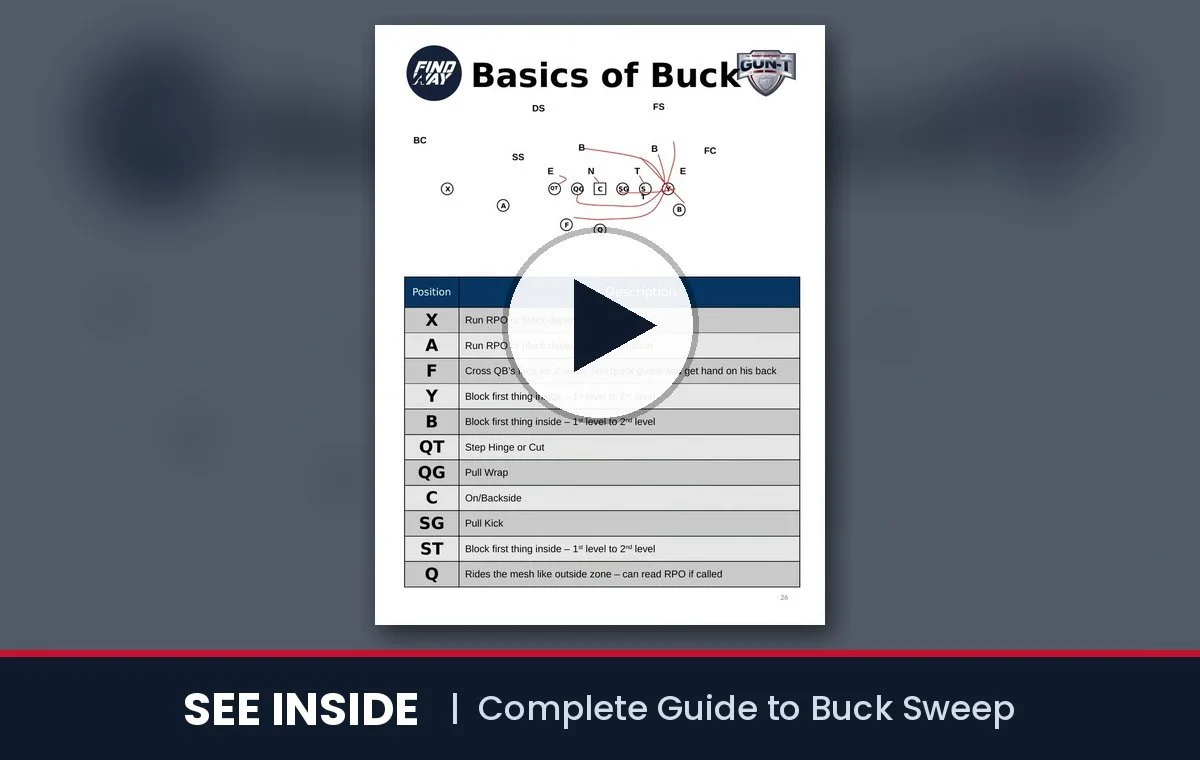
If you want to see the most common breakdowns laid out with the fixes side by side, start with my free 3 Main Problems with Buck and Solutions PowerPoint, it costs nothing and it'll probably solve the exact issue you're fighting. When you're ready to go deeper on the diagnosis, the Problems and Fixes with Buck Sweep breakdown walks through every one of these in detail. And if you want the full install from the ground up, the Complete Guide to Buck Sweep From the Gun gives you the whole system, blocking rules and all.