Every high school defense needs a coverage it can hang its hat on, one the kids can line up in every single snap and play without hesitating. For most of us, that coverage is the cover 3 defense. It's three deep and four under, everybody with a landmark, and it's about as sound a starting point as you'll find against the modern high school passing game. I've run a lot of coverages over the years, and I keep coming back to cover 3 for one simple reason. It lets a normal roster play fast, and speed on defense hides a lot of sins.
The trouble is most coaches teach it like they're teaching a college secondary, all pattern-match rules and NFL terminology, and then they wonder why their kids are a step slow and getting beat deep. It doesn't have to be that way. If you teach cover 3 one piece at a time and give every kid a landmark he owns, you'll have a coverage that holds up in September instead of one that finally clicks in November.
Why cover 3 coverage fits high school
The first thing cover 3 gives you is protection over the top. You've got three defenders splitting the deep part of the field into thirds, which means nobody has to cover the whole field by himself and you're rarely getting beat over the top on a busted assignment. In high school, the deep ball is where games get flipped in a hurry. One blown coverage and a fast kid, and it's six the other way. Cover 3 is built so that the worst thing that usually happens is a completion in front of you, not behind you, and I'll take that trade every Friday.
The second thing it gives you is simple rules, and simple rules are why kids play fast. In cover 3 every defender has a landmark and a job, and he can know exactly what he owns before the ball is even snapped. That matters more than anything fancy, because in high school you lose on defense when a kid is thinking instead of reacting. A half-second of hesitation is the whole play. When the rules are clean, the kid trusts his eyes and cuts it loose, and a fast defender who's a little out of position beats a slow one who's exactly right.
The third thing, and people underrate this, is that it pairs cleanly with pressure. Because you're only asking three men to cover deep and four to cover underneath, you've got the numbers to bring an extra rusher and stay sound behind it. If you're running an aggressive front like the 34 Swarm, cover 3 is a natural fit behind your blitz because the coverage rules don't change when you send pressure. Your kids keep the same landmarks whether you rush four or five, and that consistency is worth more than any exotic wrinkle.
How to teach cover 3 so it holds up
When people ask how to teach cover 3, my answer is always the same. You teach it in layers, and you don't add the next layer until the one under it is automatic. Break it into the deep three and the underneath four, and rep each job cold before you ever put it all together against a real offense.
- Start with the deep-third landmarks. Each of your three deep defenders owns a third of the field, and he plays from the top down, keeping everything in front of him and inside of him. Rep the drop and the landmark until nobody has to think about where his help is.
- Teach the corners and free safety to read the pattern, not the receiver. The deep defenders open to their third and read the routes coming at them, staying square and patient instead of chasing the first man they see. This is where four verticals gets defended, and it's the part that takes the most reps.
- Nail down the curl-flat responsibilities underneath. Your four underneath defenders each own a curl-to-flat area, and they carry vertical routes to the deep guys before they settle and squeeze the curl. Get them to see route distribution and pass off cleanly so nobody chases and leaves a hole.
- Fit it against the run before you trust it on Friday. Cover 3 has to be a nine-man run fit when a run-heavy team tries you, so teach your underneath players and your rolled-up safety to trigger downhill on run action. Sound coverage that can't tackle the dive is no good to anybody.
- Install the one answer for flood and four verticals. These are the two ways cover 3 gets beat, a flood that stretches a flat defender three-on-two, or four verts that puts your middle defender in a bind. Give the kids one simple rule for each, a pattern-read on the verts and a clean pass-off on the flood, and don't overload them with five checks when one will do.
Notice the order. Deep landmarks, then the pattern read, then the underneath zones, then the run fit, then the two answers. Every step sits on the one before it, so nothing gets thrown away and a kid is never asked to learn the hard part before the easy part is automatic.
Keep it simple and let them play fast
The whole point of cover 3 is speed and confidence. A kid who knows his third and trusts his help plays a step faster than a kid who's still processing, and that step is the difference between a pass breakup and a touchdown. Cover 3 gives you a sound, teachable coverage that stands up against the spread and the run-heavy team both, and it fits behind pressure without changing a single rule. That's the entire test. It has to be sound, it has to be teachable, and everything has to show up on Friday night.
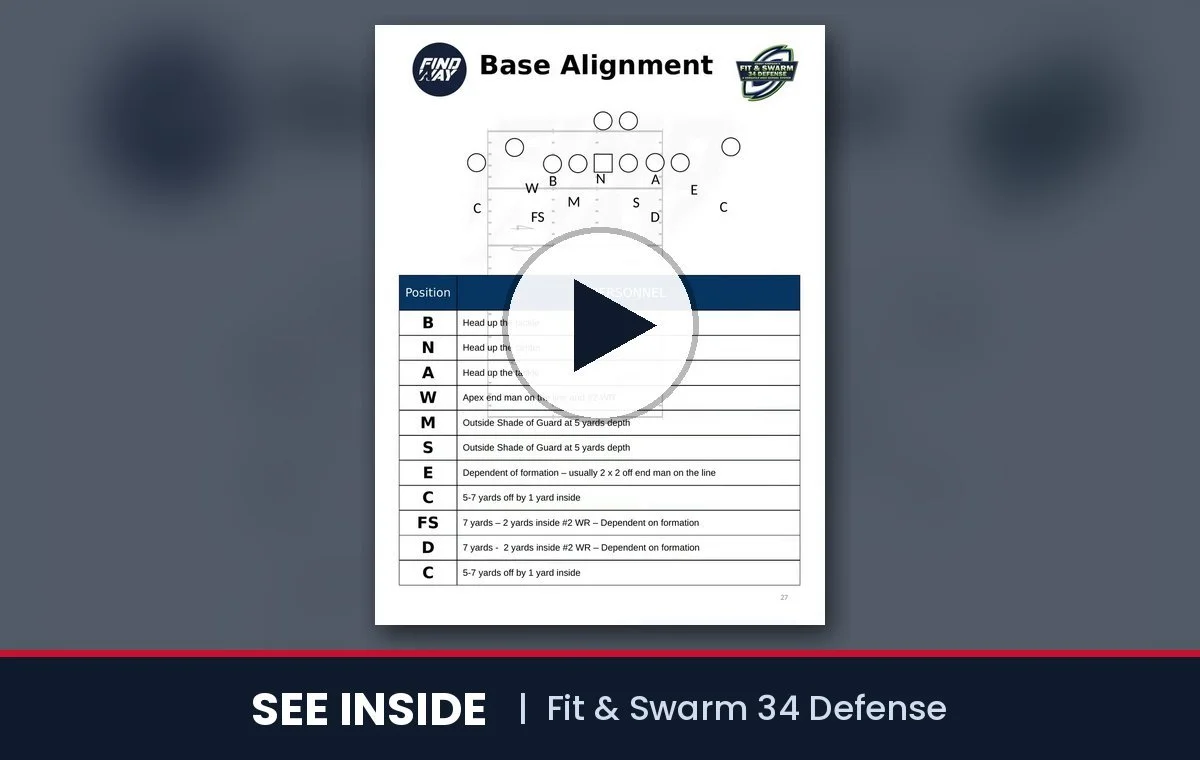
If you want to see how I fit the coverage behind pressure, start with the 34 Swarm Blitz and Coverage Overview, which lays out how the blitzes and the coverage work together. For the fits and the philosophy the way I actually teach them, the 34 Fit and Swarm Defensive Overview Book walks through it one piece at a time. And when you're ready for the whole system, front to coverage, the 34 Swarm Combo Pack ties it all together. Teach it one layer at a time, and let your kids play fast. If you want those coverage calls numbered and sitting on one page your kids can read on the sideline, the 34 Swarm Defensive Call Sheet does exactly that. If you are new to the front all of this sits on, the 3-4 Defense Overview is free and a good place to start.