I've been on both ends of it. I've stood in a locker room at 0-10, looking at kids who had stopped believing anything I said, and I've stood in one years later at 10-0 with a program that had never won anything before I got there. I tell you that not to brag, because the 0-10 team humbled me in a way I still think about, but because I want you to know that when I talk about how to turn around a football program, I'm not talking about theory. I've lived the losing and I've lived the winning, and the distance between them was not talent, and it was not a magic scheme. It was a set of unglamorous things I did every single day whether anybody was watching or not.
Most coaches who take over a bad program want to change the record first. That's natural, the record is what everybody sees, and it's what got the last guy fired. But the record is the last thing that changes, not the first. If you chase wins directly you'll cut corners, you'll lean on your three best players, and you'll build something that collapses the first time those three kids graduate or get hurt. The record is an output. You have to go fix the inputs, and the inputs are boring.
You fall to the level of your systems
There's a saying that you don't rise to the level of your goals, you fall to the level of your systems, and nowhere is that truer than a broken program. When I was 0-10, I had big goals. I had a nice speech about them. What I did not have was a system that produced the behavior those goals required. Kids showed up late because there was no system that made showing up on time normal. We got beat in the fourth quarter because there was no offseason system that made us the tougher team in December. Every part of that record traced back to something I hadn't built yet.
So when I talk about turning a program around, understand that I mean building systems, not giving speeches. A system is what happens when you're not standing there watching. It's the standard that holds when you're tired, when the seniors are testing you, when you're 1-4 and it would be easy to let one thing slide. The teams that turn around are the ones where the standard doesn't depend on the coach's mood that day, because it's built into how everything runs.
Culture is what you tolerate, not what you post
Everybody wants to talk about culture now, and most of it is a slogan on a wall. Culture isn't your motto. Culture is the worst behavior you're willing to walk past. If your best player loafs on a rep and you say nothing, that's your culture now, and every kid on the field just learned what the standard really is. The turnaround started for me the day I was willing to hold my best player to the same line as my twelfth guy, and pay the short term price of him being mad at me.
That's the hard part nobody warns you about. Setting the standard is easy. Holding it when it costs you something is the whole job. The first time you bench a starter for missing a workout, you find out if your standard is real. The kids are watching that moment far more closely than any speech, and they'll decide right there whether the new way is serious or just noise.
Develop everybody, not just the ones who are ready
A losing program is usually a program that has quit on most of its roster. The starters get coached and everybody else gets managed, and then people wonder why there's no depth and no future. When I turned things around, the biggest change in my daily practice was how much attention the bottom half of the roster got. Your twelfth through thirtieth players are your program's future, and they're the ones who decide whether your standard is real, because if the standard only applies to the stars then it isn't a standard at all.
Developing everybody is slow and it's unglamorous, and it never shows up in a highlight video. But it's the thing that turns one good season into a decade of them. The sophomore you actually coached this year is your starter in two years, and the culture he learned in the bottom of the roster is the culture he'll enforce as a senior. That compounding is the real engine of a turnaround, and it only runs if you're willing to invest in kids who won't pay you back until long after the current season is over.
The daily work is the whole thing
None of this is exciting, and that's the point. The turnaround isn't a moment, it's a thousand small reps of doing it right when nobody would notice if you didn't. Here's what that looked like for me, and what I'd tell any coach taking over a program that's down:
- Set three or four non-negotiables and never blink on them. On time, full effort, take care of your stuff, treat teammates right. Fewer rules, held harder, beat a long list nobody enforces.
- Build the offseason first. Fourth quarters are won in February. The weight room and the summer are where a soft program becomes a tough one.
- Coach the bottom of the roster like they're starters. Depth and future both live down there, and so does your real culture.
- Pick systems you can teach to everyone, on offense, defense, and in how you run a practice. If it only works with elite kids, it won't survive a rebuild.
- Hold the standard when it costs you. Bench the star who cut the corner. That one decision teaches more than a season of talks.
- Measure the inputs, not the scoreboard. Attendance, effort, weight room numbers, missed assignments. Fix those and the record follows.
I won't pretend the wins came fast, because they didn't. The record was the last thing to move, exactly like I said. But the day-to-day changed long before the scoreboard did, and if I'd been honest enough to measure the day-to-day, I'd have seen the turnaround coming while I was still losing games. The kids bought in because the standard was the same every day, for everybody, whether we won on Friday or not. And eventually all that unglamorous work showed up where it counts, because in the end everything has to show up on Friday night.
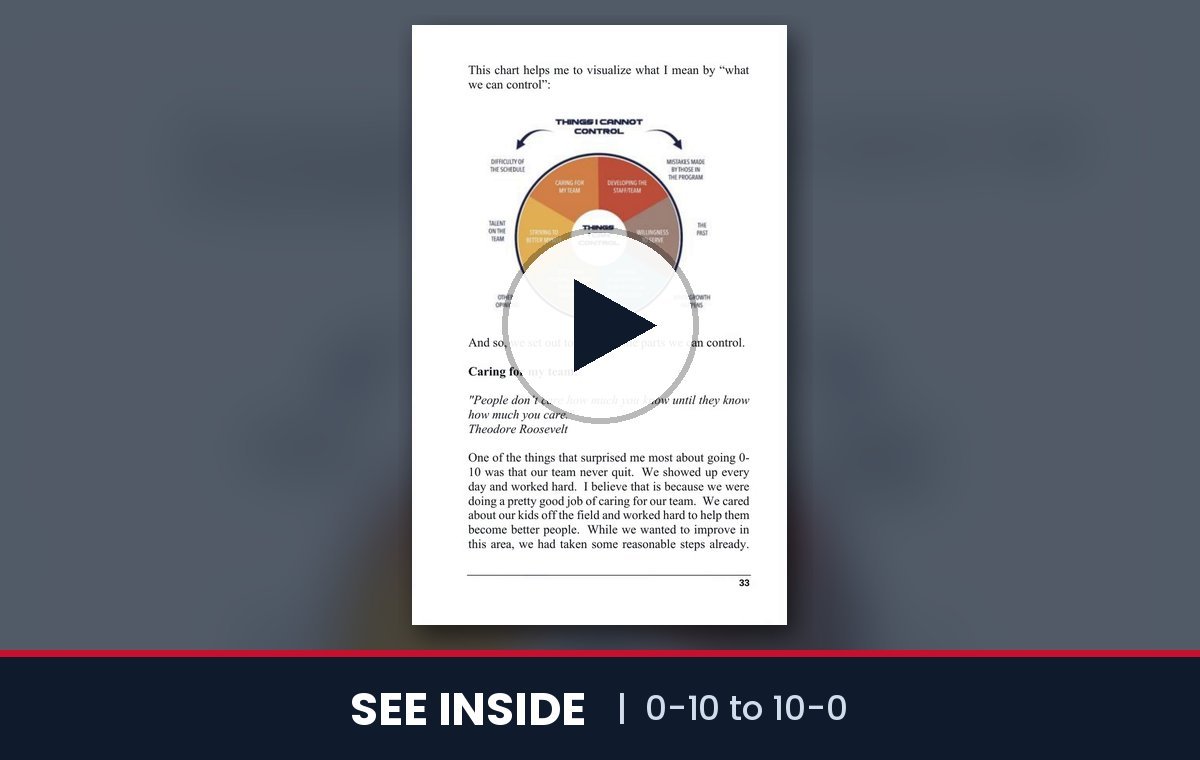
If you're taking over a program that's down, or you're grinding through the losing part right now and wondering if it's ever going to turn, I wrote the whole story and the whole method down in the 0-10 to 10-0 book. It's the honest version, the mistakes I made at the bottom and the systems that eventually pulled us to the top. You don't have to learn it the slow way like I did. Go build the inputs, and let the record catch up.
I wrote the 0-10 to 10-0 Book about this exact stretch, because I lived both ends of it. The First 90 Days on the Job Checklist is the front end if you just took the job, and the Head Coach Workbook is the structure that keeps a turnaround from running on your energy alone.