You spend all week figuring out what a team does on second and long out of trips. Your coordinator knows exactly what he wants against it. Then it is third and six, the crowd is loud, the offense is in a hurry, and the sideline is confused.
That is not a scheme problem. That is a paper problem, and paper problems are the cheapest ones you will ever fix.
A call sheet keeps you from coaching off memory
Late in a close game you are tired, you are behind on the play clock, and your memory is the worst it has been all night. A call sheet is what carries the plan through that stretch. The coach with fewer calls and a good sheet will out-call the coach with more calls and no sheet almost every time.
Build the sheet around two questions, because those are the only two you actually have time to ask. What down and distance is it, and what are they lined up in. If your sheet answers those two things in about a second, you are in good shape.
Color code by down
First down in one color, second in another, third and fourth in their own. You are not doing that so it looks nice. You are doing it so your eye lands in the right block before you read a single word, and at full speed, finding the right block is most of the job.
Lay the downs against the formations you actually expect to see. Four is usually the right number. Any more than that and you are building a research paper instead of a call sheet, and you will not be able to find anything on it when it is loud.
Number your pressures and your coverages
Keep your blitzes in one numbered menu and your coverages in another, and put both of them off to the side where your thumb can find them. When they are numbered, a call is two numbers instead of a sentence. Blitz three with coverage two, and it goes from your mouth to the signal without anyone having to think about it.
That also lets you mix on the fly. You are not hunting for a pre-written combination that fits the situation, you are stacking two things you already have.
What I use
The 34 Swarm Defensive Call Sheet is the sheet I run. It is a down-and-distance game plan laid out against four formations, color coded by down, with a numbered blitz menu and a numbered coverage menu down the right side.
It ships blank so you can build yours from scratch, plus a second copy with my 34 Swarm calls already filled in. If you run the Swarm you can print it and go. If you run something else, you still have a working example showing how the downs, the formations and the menus fit together, which is a lot easier to build from than an empty grid.
It is an editable Excel file, it is five dollars, and you can have it filled in and printed before your next game.
What to do this week
Pull your last two opponents and list the four formations you actually saw most. Those are your columns.
Lay the sheet out by down before you put a single call on it.
Give each down its own color and keep those colors the same every week, so your eye trains itself.
Number your pressures and your coverages so any call is two numbers.
Print it Thursday, not Friday afternoon, and walk your coordinator through it once before you ever need it.
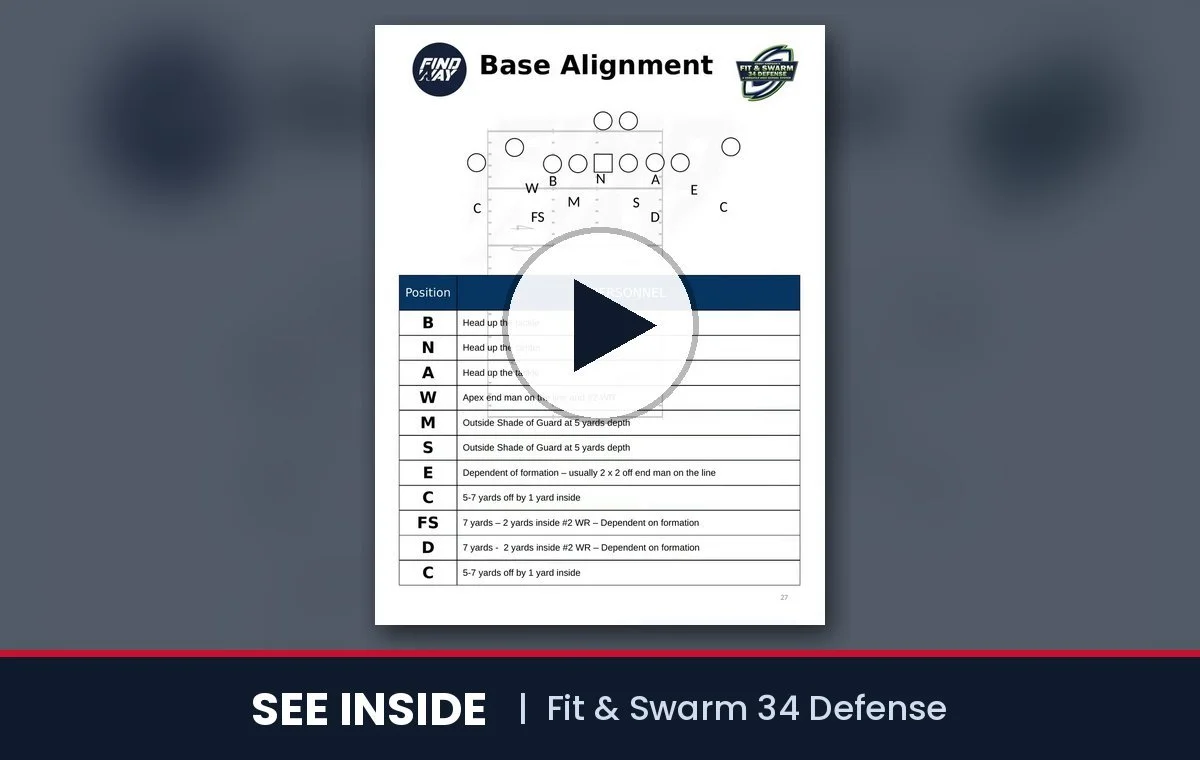
The sheet is here: 34 Swarm Defensive Call Sheet. If you want the defense behind it, start with the 34 Swarm Overview. And if you are setting up the offensive side of the same problem, the Gun T Offensive Wristband Template does it for your players.