Every defensive coach will tell you tackling is the most important thing they do, and most of them spend about ten minutes a week actually teaching it. That's the honest truth of high school football. We'll spend an hour installing a blitz package our kids run twice a season, then wonder why we're missing tackles in the open field in October. If you want to know how to teach tackling so it holds up when the lights come on, you have to stop treating it like a topic and start treating it like a habit. A speech doesn't tackle anybody. Reps do.
Tackling is a skill, and like any skill it gets built by doing it correctly over and over until the body doesn't have to think. The problem is that live tackling is the one thing every coach is scared to rep, and for good reason. You've got a limited roster, you can't afford to lose kids to contact injuries in a Tuesday practice, and full-speed live tackling every day would put half your team in the training room by district play. So most coaches solve that by barely tackling at all, and then they're shocked when their kids can't do it on Friday. The answer isn't more collisions. It's more quality reps at controlled speeds, which is exactly how you teach tackling fundamentals safely.
Why quality reps beat live collisions
Here's what took me too long to understand. A kid does not need to blow somebody up to learn how to tackle. He needs to learn where to put his feet, where to put his eyes, and where to fit his shoulder, and he can learn all of that at a speed that keeps everybody healthy. Full-contact live work has its place, but you can get the bulk of your teaching done without it if you use tempo.
We run most of our tackling on a ladder of speeds. It starts with fit-and-freeze, where the tackler walks up, fits the correct position on the ball carrier, and holds it so the coach can check every detail. Then you move to a tag-off or a thud tempo where they track and break down and fit at game speed but they don't take the runner to the ground. Then, when you want live, you go live in a controlled setting like a low-to-high or a sideline drill where the space is small and the angles are safe. Angle and tempo tackling gets you the reps without the wear, and that's how you build safe tackling that still shows up under the lights.
The coaching points that actually matter
You can teach good tackling with a short list of points, and you should keep it short because a kid can't think about eight things while a running back is coming at him. These are the ones we live on.
- Track the near hip and take a good angle. A tackle is won before contact by the path you run. Teach kids to track the near hip of the ball carrier so they don't overrun the play or leave a cutback lane.
- Break down and shorten your steps. As you close, chop your feet and get your weight under you so you can react to a cut. A kid running full-speed with long strides can't redirect, and that's where the missed tackles come from.
- Near foot, near shoulder. Step on the near foot and fit the near shoulder into the ball carrier. This keeps you square, keeps you from lunging, and puts your body in a leveraged position instead of a reaching one.
- Eyes up, see what you hit. We never drop the crown of the helmet. Eyes up and see what you hit keeps the head out of the tackle, which is both safer for the neck and head and technically better, because you can't wrap what you can't see.
- Wrap and run your feet. Contact doesn't finish the tackle, the feet do. Wrap the arms, grab cloth, and keep the feet driving so the runner goes down instead of falling forward for extra yards.
That fourth point is the one I'd underline twice. Shoulder-leverage tackling, what a lot of coaches now call hawk or shoulder tackling, takes the head out of harm's way and it's the safer way to bring somebody down. You're fitting the shoulder and wrapping, not launching the helmet. It's better for the kid's body and it holds up against good backs, so there's no trade-off between safe tackling and effective tackling. They're the same thing when you teach it right.
Build a short circuit and run it every single day
The mistake I made for years was treating tackling like an August installation. We'd hammer it in camp, feel good about it, and then let it slide once the games started and the game plan took over the practice schedule. Then the fundamentals would erode quietly until a Friday reminded us. Tackling is not something you install, it's something you maintain, and you maintain it with a short daily circuit that never leaves the practice plan.
Ours is about ten minutes, early in practice while legs are fresh. Two or three stations, a tracking drill, a fit-and-freeze or angle station, and one live-tempo finish, rotating so every kid gets real reps. Ten minutes a day, every day, all season, adds up to more quality tackling work than the teams around you are getting, and it shows in November. A team that tackles well covers for a lot of scheme mistakes, because a blown gap or a busted coverage is a five-yard gain instead of a touchdown when the first man to the ball actually brings the runner down.
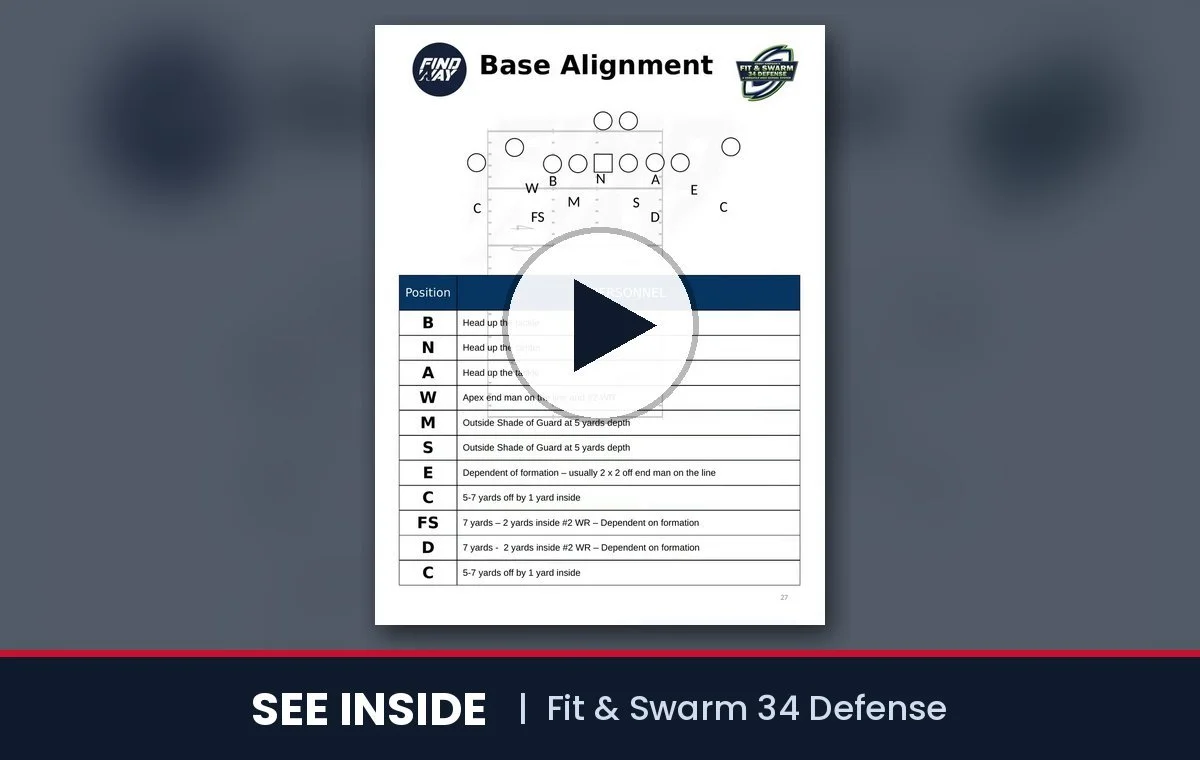
If you want the way I teach fits, leverage, and block destruction to your front, the 34 Defensive Line Manual lays out the technique the way we drill it. For the whole picture of how the tackling and the pursuit tie into the scheme, the 34 Fit and Swarm Defensive Overview Book puts it in context, and if you want to run it like a coordinator with the practice organization and daily plan built in, the Defensive Coordinator Workbook Combo ties it together. Teach it correctly, rep it safely, and rep it every day, because everything has to show up on Friday night. The 3-4 Defense Overview is free and shows the front these fits live inside.